
Docker容器与虚拟化技术:Docker compose部署LNMP
目录
一、理论
1.LNMP架构
2.背景
3.Dockerfile部署LNMP
3.准备Nginx镜像
4.准备MySQL容器
5.准备PHP镜像
6.上传wordpress软件包
7.编写docker-compose.yml
8.构建与运行docker-compose
9.启动 wordpress 服务
10.浏览器访问
11.将运行中的 docker容器保存为 docker 镜像并保存到本地tar包
二、实验
1.环境准备
2.准备Nginx镜像
3.准备MySQL容器
4.准备PHP镜像
5.上传wordpress软件包
6.docker compose构建项目
7.启动 wordpress 服务
8.将所有容器进行快照,然后将Docker镜像打包成tar包备份到本地
三、问题
一、理论
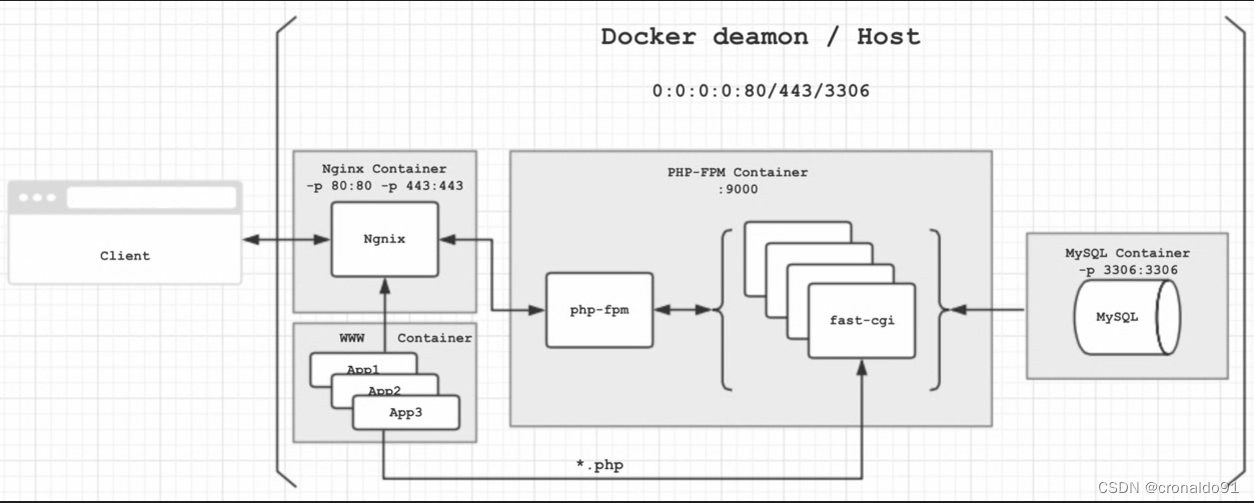
1.LNMP架构
(1)架构
搭建一个lnmp环境,需要涉及到两个目录结构和一个yml配置文件。一个是Dockerfile配置的目录结构,另一个是最终lnmp运行的目录结构。Dockerfile配置目录主要存放Dockerfile构建脚本和一些配置文件,lnmp运行目录主要存放程序运行产生的一些数据,比如mysql数据等。
以下是此次Dockerfile配置的目录结构,包括了nginx、php、mysql的配置文件。
[root@localhost opt]# tree /opt/compose_lnmp/ -L 2
/opt/compose_lnmp/
├── docker-compose.yml
├── mysql
│   ├── Dockerfile
│   ├── my.cnf
│   └── mysql-boost-5.7.20.tar.gz
├── nginx
│   ├── Dockerfile
│   ├── nginx-1.12.0.tar.gz
│   ├── nginx.conf
│   └── wordpress-4.9.4-zh_CN.tar.gz
├── php
│   ├── Dockerfile
│   ├── php-7.1.10.tar.bz2
│   ├── php-fpm.conf
│   ├── php.ini
│   └── www.conf
└── wwwroot├── index.html├── wordpress└── wordpress-4.9.4-zh_CN.tar.gz
2.背景
(1)项目环境
公司在实际的生产环境中,需要使用 Docker 技术在一台主机上创建 LNMP 服务并运行 Wordpress 网站平台。然后对此服务使用docker-compose管理工作。
(2)所有安装包下载
nginx:
nginx:下载
MySQL:
MySQL :: MySQL 下载
PHP:
PHP: 下载
(3)任务需求
使用Docker构建LNMP环境并运行Wordpress网站平台。
为了方便运维和统一管理使用进行docker-compose编排
将所有容器进行快照,然后将Docker镜像打包成tar包备份到本地。
把docker-compose.yml 复制到文档中
3.Dockerfile部署LNMP
(1)关闭防火墙
systemctl stop firewalld
systemctl disable firewalld
setenforce 0
Docker各组件的ip为:
| 容器 | 操作系统 | IP地址 | 主要软件 |
| nginx | CentOS 7 | 172.20.0.10 | Docker-Nginx |
| mysql | CentOS 7 | 172.20.0.20 | Docker-Mysql |
| php | CentOS 7 | 172.20.0.30 | Docker-php |
此实验所需的软件有:
mysql-boost-5.7.20.tar.gz
nginx-1.12.0.tar.gz
php-7.1.10.tar.bz2
wordpress-4.9.4-zh_CN.tar.gz
3.准备Nginx镜像
(1) 创建nginx的工作目录
mkdir /opt/nginx
cd /opt/nginx/
(2) 上传 nginx-1.12.0.tar.gz、wordpress-4.9.4-zh_CN.tar.gz 到 /opt/nginx/ 目录中
[root@localhost nginx]# rz -E
rz waiting to receive.
[root@localhost nginx]# ls
Dockerfile  nginx-1.12.0.tar.gz  nginx.conf  run.sh  wordpress-4.9.4-zh_CN.tar.gz
(3)编辑Dockerfile配置文件
vim DockerfileFROM centos:7
MAINTAINER this is nginx image <wl>
RUN yum -y install pcre-devel zlib-devel gcc gcc-c++ make && useradd -M -s /sbin/nologin nginx
ADD nginx-1.12.0.tar.gz /usr/local/src/
WORKDIR /usr/local/src/nginx-1.12.0
RUN ./configure \
--prefix=/usr/local/nginx \
--user=nginx \
--group=nginx \
--with-http_stub_status_module && make -j2 && make install
ENV PATH /usr/local/nginx/sbin:$PATH
ADD nginx.conf /usr/local/nginx/conf/
#ADD wordpress-4.9.4-zh_CN.tar.gz /usr/local/nginx/html/
RUN chmod 777 -R /usr/local/nginx/html/
EXPOSE 80
EXPOSE 443
ENTRYPOINT [ "/usr/local/nginx/sbin/nginx", "-g", "daemon off;" ]
(4) 准备Dockerfile文件中所需要的其他配置文件
vim nginx.conf
#user  nobody;
worker_processes  1;#error_log  logs/error.log;
#error_log  logs/error.log  notice;
#error_log  logs/error.log  info;#pid        logs/nginx.pid;events {worker_connections  1024;
}http {include       mime.types;default_type  application/octet-stream;#log_format  main  '$remote_addr - $remote_user [$time_local] "$request" '#                  '$status $body_bytes_sent "$http_referer" '#                  '"$http_user_agent" "$http_x_forwarded_for"';#access_log  logs/access.log  main;sendfile        on;#tcp_nopush     on;#keepalive_timeout  0;keepalive_timeout  65;#gzip  on;server {listen       80;server_name  localhost;charset utf-8;#access_log  logs/host.access.log  main;location / {root   html;index  index.html index.php;}#error_page  404              /404.html;# redirect server error pages to the static page /50x.html#error_page   500 502 503 504  /50x.html;location = /50x.html {root   html;}# proxy the PHP scripts to Apache listening on 127.0.0.1:80##location ~ \.php$ {#    proxy_pass   http://127.0.0.1;#}# pass the PHP scripts to FastCGI server listening on 127.0.0.1:9000#location ~ \.php$ {root           html;fastcgi_pass   172.18.0.30:9000;fastcgi_index  index.php;fastcgi_param  SCRIPT_FILENAME  /usr/local/nginx/html$fastcgi_script_name;include        fastcgi_params;}# deny access to .htaccess files, if Apache's document root# concurs with nginx's one##location ~ /\.ht {#    deny  all;#}}# another virtual host using mix of IP-, name-, and port-based configuration##server {#    listen       8000;#    listen       somename:8080;#    server_name  somename  alias  another.alias;#    location / {#        root   html;#        index  index.html index.htm;#    }#}# HTTPS server##server {#    listen       443 ssl;#    server_name  localhost;#    ssl_certificate      cert.pem;#    ssl_certificate_key  cert.key;#    ssl_session_cache    shared:SSL:1m;#    ssl_session_timeout  5m;#    ssl_ciphers  HIGH:!aNULL:!MD5;#    ssl_prefer_server_ciphers  on;#    location / {#        root   html;#        index  index.html index.htm;#    }#}}
4.准备MySQL容器
(1) 创建MySQL工作目录
mkdir /opt/mysqld
cd /opt/mysqld
(2) 上传 mysql-boost-5.7.20.tar.gz 到 /opt/mysqld 目录中
[root@localhost mysql]# rz -E
rz waiting to receive.
[root@localhost mysql]# ls
mysql-boost-5.7.20.tar.gz
(3) 编辑Dockerfile文件
vim Dockerfile FROM centos:7
MAINTAINER this is mysql image <wl>
RUN yum -y install gcc gcc-c++ ncurses ncurses-devel bison cmake make
ADD mysql-boost-5.7.20.tar.gz /usr/local/src/
WORKDIR /usr/local/src/mysql-5.7.20/
RUN cmake \
-DCMAKE_INSTALL_PREFIX=/usr/local/mysql \
-DMYSQL_UNIX_ADDR=/usr/local/mysql/mysql.sock \
-DSYSCONFDIR=/etc \
-DSYSTEMD_PID_DIR=/usr/local/mysql \
-DDEFAULT_CHARSET=utf8 \
-DDEFAULT_COLLATION=utf8_general_ci \
-DWITH_INNOBASE_STORAGE_ENGINE=1 \
-DMYSQL_DATADIR=/usr/local/mysql/data \
-DWITH_BOOST=boost \
-DWITH_SYSTEMD=1 && make -j2 && make install
ADD my.cnf /etc/
ENV PATH=/usr/local/mysql/bin:/usr/local/mysql/lib:$PATH
RUN useradd -M -s /sbin/nologin mysql && chown mysql:mysql /etc/my.cnf && chown -R mysql:mysql /usr/local/mysql/ && /usr/local/mysql/bin/mysqld \
--initialize-insecure \
--user=mysql \
--basedir=/usr/local/mysql \
--datadir=/usr/local/mysql/data && cp /usr/local/mysql/usr/lib/systemd/system/mysqld.service /usr/lib/systemd/system/
EXPOSE 3306
CMD ["/usr/local/mysql/bin/mysqld"]
(4)编辑mysql的配置文件
vim my.cnfFROM centos:7
MAINTAINER this is mysql image <wl>
RUN yum -y install gcc gcc-c++ ncurses ncurses-devel bison cmake make
ADD mysql-boost-5.7.20.tar.gz /usr/local/src/
WORKDIR /usr/local/src/mysql-5.7.20/
RUN cmake \
-DCMAKE_INSTALL_PREFIX=/usr/local/mysql \
-DMYSQL_UNIX_ADDR=/usr/local/mysql/mysql.sock \
-DSYSCONFDIR=/etc \
-DSYSTEMD_PID_DIR=/usr/local/mysql \
-DDEFAULT_CHARSET=utf8 \
-DDEFAULT_COLLATION=utf8_general_ci \
-DWITH_INNOBASE_STORAGE_ENGINE=1 \
-DMYSQL_DATADIR=/usr/local/mysql/data \
-DWITH_BOOST=boost \
-DWITH_SYSTEMD=1 && make -j2 && make install
ADD my.cnf /etc/
ENV PATH=/usr/local/mysql/bin:/usr/local/mysql/lib:$PATH
RUN useradd -M -s /sbin/nologin mysql && chown mysql:mysql /etc/my.cnf && chown -R mysql:mysql /usr/local/mysql/ && /usr/local/mysql/bin/mysqld \
--initialize-insecure \
--user=mysql \
--basedir=/usr/local/mysql \
--datadir=/usr/local/mysql/data && cp /usr/local/mysql/usr/lib/systemd/system/mysqld.service /usr/lib/systemd/system/
EXPOSE 3306
CMD ["/usr/local/mysql/bin/mysqld"]
5.准备PHP镜像
(1) 创建工作目录
mkdir /opt/php
cd /opt/php
(2)上传 php-7.1.10.tar.bz2 到 /opt/php 目录中
[root@localhost php]# ls
[root@localhost php]# rz -E
rz waiting to receive.
[root@localhost php]# ls
php-7.1.10.tar.bz2  php-fpm.conf  php.ini  www.conf
(3)编辑Dockerfile文件
vim Dockerfile FROM centos:7
MAINTAINER this is php image <wl>
RUN yum -y install gd \
libjpeg libjpeg-devel \
libpng libpng-devel \
freetype freetype-devel \
libxml2 libxml2-devel \
zlib zlib-devel \
curl curl-devel \
openssl openssl-devel \
gcc gcc-c++ make pcre-devel && useradd -M -s /sbin/nologin nginx
ADD php-7.1.10.tar.bz2 /usr/local/src/
WORKDIR /usr/local/src/php-7.1.10
RUN ./configure \
--prefix=/usr/local/php \
--with-mysql-sock=/usr/local/mysql/mysql.sock \
--with-mysqli \
--with-zlib \
--with-curl \
--with-gd \
--with-jpeg-dir \
--with-png-dir \
--with-freetype-dir \
--with-openssl \
--enable-fpm \
--enable-mbstring \
--enable-xml \
--enable-session \
--enable-ftp \
--enable-pdo \
--enable-tokenizer \
--enable-zip && make -j2 && make install
ENV PATH /usr/local/php/bin:/usr/local/php/sbin:$PATH
ADD php.ini /usr/local/php/lib/
ADD php-fpm.conf /usr/local/php/etc/
ADD www.conf /usr/local/php/etc/php-fpm.d/
EXPOSE 9000
ENTRYPOINT [ "/usr/local/php/sbin/php-fpm", "-F" ]
(4)准备Dockerfile需要的PHP配置文件
①配置php.ini文件
vim php.ini[PHP];;;;;;;;;;;;;;;;;;;
; About php.ini ;
;;;;;;;;;;;;;;;;;;;
; PHP's initialization file, generally called php.ini, is responsible for
; configuring many of the aspects of PHP's behavior.; PHP attempts to find and load this configuration from a number of locations.
; The following is a summary of its search order:
; 1. SAPI module specific location.
; 2. The PHPRC environment variable. (As of PHP 5.2.0)
; 3. A number of predefined registry keys on Windows (As of PHP 5.2.0)
; 4. Current working directory (except CLI)
; 5. The web server's directory (for SAPI modules), or directory of PHP
; (otherwise in Windows)
; 6. The directory from the --with-config-file-path compile time option, or the
; Windows directory (C:\windows or C:\winnt)
; See the PHP docs for more specific information.
; http://php.net/configuration.file; The syntax of the file is extremely simple. Whitespace and lines
; beginning with a semicolon are silently ignored (as you probably guessed).
; Section headers (e.g. [Foo]) are also silently ignored, even though
; they might mean something in the future.; Directives following the section heading [PATH=/www/mysite] only
; apply to PHP files in the /www/mysite directory. Directives
; following the section heading [HOST=www.example.com] only apply to
; PHP files served from www.example.com. Directives set in these
; special sections cannot be overridden by user-defined INI files or
; at runtime. Currently, [PATH=] and [HOST=] sections only work under
; CGI/FastCGI.
; http://php.net/ini.sections; Directives are specified using the following syntax:
; directive = value
; Directive names are *case sensitive* - foo=bar is different from FOO=bar.
; Directives are variables used to configure PHP or PHP extensions.
; There is no name validation. If PHP can't find an expected
; directive because it is not set or is mistyped, a default value will be used.; The value can be a string, a number, a PHP constant (e.g. E_ALL or M_PI), one
; of the INI constants (On, Off, True, False, Yes, No and None) or an expression
; (e.g. E_ALL & ~E_NOTICE), a quoted string ("bar"), or a reference to a
; previously set variable or directive (e.g. ${foo}); Expressions in the INI file are limited to bitwise operators and parentheses:
; | bitwise OR
; ^ bitwise XOR
; & bitwise AND
; ~ bitwise NOT
; ! boolean NOT; Boolean flags can be turned on using the values 1, On, True or Yes.
; They can be turned off using the values 0, Off, False or No.; An empty string can be denoted by simply not writing anything after the equal
; sign, or by using the None keyword:; foo = ; sets foo to an empty string
; foo = None ; sets foo to an empty string
; foo = "None" ; sets foo to the string 'None'; If you use constants in your value, and these constants belong to a
; dynamically loaded extension (either a PHP extension or a Zend extension),
; you may only use these constants *after* the line that loads the extension.;;;;;;;;;;;;;;;;;;;
; About this file ;
;;;;;;;;;;;;;;;;;;;
; PHP comes packaged with two INI files. One that is recommended to be used
; in production environments and one that is recommended to be used in
; development environments.; php.ini-production contains settings which hold security, performance and
; best practices at its core. But please be aware, these settings may break
; compatibility with older or less security conscience applications. We
; recommending using the production ini in production and testing environments.; php.ini-development is very similar to its production variant, except it is
; much more verbose when it comes to errors. We recommend using the
; development version only in development environments, as errors shown to
; application users can inadvertently leak otherwise secure information.; This is php.ini-development INI file.;;;;;;;;;;;;;;;;;;;
; Quick Reference ;
;;;;;;;;;;;;;;;;;;;
; The following are all the settings which are different in either the production
; or development versions of the INIs with respect to PHP's default behavior.
; Please see the actual settings later in the document for more details as to why
; we recommend these changes in PHP's behavior.; display_errors
; Default Value: On
; Development Value: On
; Production Value: Off; display_startup_errors
; Default Value: Off
; Development Value: On
; Production Value: Off; error_reporting
; Default Value: E_ALL & ~E_NOTICE & ~E_STRICT & ~E_DEPRECATED
; Development Value: E_ALL
; Production Value: E_ALL & ~E_DEPRECATED & ~E_STRICT; html_errors
; Default Value: On
; Development Value: On
; Production value: On; log_errors
; Default Value: Off
; Development Value: On
; Production Value: On; max_input_time
; Default Value: -1 (Unlimited)
; Development Value: 60 (60 seconds)
; Production Value: 60 (60 seconds); output_buffering
; Default Value: Off
; Development Value: 4096
; Production Value: 4096; register_argc_argv
; Default Value: On
; Development Value: Off
; Production Value: Off; request_order
; Default Value: None
; Development Value: "GP"
; Production Value: "GP"; session.gc_divisor
; Default Value: 100
; Development Value: 1000
; Production Value: 1000; session.sid_bits_per_character
; Default Value: 4
; Development Value: 5
; Production Value: 5; short_open_tag
; Default Value: On
; Development Value: Off
; Production Value: Off; track_errors
; Default Value: Off
; Development Value: On
; Production Value: Off; variables_order
; Default Value: "EGPCS"
; Development Value: "GPCS"
; Production Value: "GPCS";;;;;;;;;;;;;;;;;;;;
; php.ini Options ;
;;;;;;;;;;;;;;;;;;;;
; Name for user-defined php.ini (.htaccess) files. Default is ".user.ini"
;user_ini.filename = ".user.ini"; To disable this feature set this option to empty value
;user_ini.filename =; TTL for user-defined php.ini files (time-to-live) in seconds. Default is 300 seconds (5 minutes)
;user_ini.cache_ttl = 300;;;;;;;;;;;;;;;;;;;;
; Language Options ;
;;;;;;;;;;;;;;;;;;;;; Enable the PHP scripting language engine under Apache.
; http://php.net/engine
engine = On; This directive determines whether or not PHP will recognize code between
; <? and ?> tags as PHP source which should be processed as such. It is
; generally recommended that <?php and ?> should be used and that this feature
; should be disabled, as enabling it may result in issues when generating XML
; documents, however this remains supported for backward compatibility reasons.
; Note that this directive does not control the <?= shorthand tag, which can be
; used regardless of this directive.
; Default Value: On
; Development Value: Off
; Production Value: Off
; http://php.net/short-open-tag
short_open_tag = Off; The number of significant digits displayed in floating point numbers.
; http://php.net/precision
precision = 14; Output buffering is a mechanism for controlling how much output data
; (excluding headers and cookies) PHP should keep internally before pushing that
; data to the client. If your application's output exceeds this setting, PHP
; will send that data in chunks of roughly the size you specify.
; Turning on this setting and managing its maximum buffer size can yield some
; interesting side-effects depending on your application and web server.
; You may be able to send headers and cookies after you've already sent output
; through print or echo. You also may see performance benefits if your server is
; emitting less packets due to buffered output versus PHP streaming the output
; as it gets it. On production servers, 4096 bytes is a good setting for performance
; reasons.
; Note: Output buffering can also be controlled via Output Buffering Control
; functions.
; Possible Values:
; On = Enabled and buffer is unlimited. (Use with caution)
; Off = Disabled
; Integer = Enables the buffer and sets its maximum size in bytes.
; Note: This directive is hardcoded to Off for the CLI SAPI
; Default Value: Off
; Development Value: 4096
; Production Value: 4096
; http://php.net/output-buffering
output_buffering = 4096; You can redirect all of the output of your scripts to a function. For
; example, if you set output_handler to "mb_output_handler", character
; encoding will be transparently converted to the specified encoding.
; Setting any output handler automatically turns on output buffering.
; Note: People who wrote portable scripts should not depend on this ini
; directive. Instead, explicitly set the output handler using ob_start().
; Using this ini directive may cause problems unless you know what script
; is doing.
; Note: You cannot use both "mb_output_handler" with "ob_iconv_handler"
; and you cannot use both "ob_gzhandler" and "zlib.output_compression".
; Note: output_handler must be empty if this is set 'On' !!!!
; Instead you must use zlib.output_handler.
; http://php.net/output-handler
;output_handler =; URL rewriter function rewrites URL on the fly by using
; output buffer. You can set target tags by this configuration.
; "form" tag is special tag. It will add hidden input tag to pass values.
; Refer to session.trans_sid_tags for usage.
; Default Value: "form="
; Development Value: "form="
; Production Value: "form="
;url_rewriter.tags; URL rewriter will not rewrites absolute URL nor form by default. To enable
; absolute URL rewrite, allowed hosts must be defined at RUNTIME.
; Refer to session.trans_sid_hosts for more details.
; Default Value: ""
; Development Value: ""
; Production Value: ""
;url_rewriter.hosts; Transparent output compression using the zlib library
; Valid values for this option are 'off', 'on', or a specific buffer size
; to be used for compression (default is 4KB)
; Note: Resulting chunk size may vary due to nature of compression. PHP
; outputs chunks that are few hundreds bytes each as a result of
; compression. If you prefer a larger chunk size for better
; performance, enable output_buffering in addition.
; Note: You need to use zlib.output_handler instead of the standard
; output_handler, or otherwise the output will be corrupted.
; http://php.net/zlib.output-compression
zlib.output_compression = Off; http://php.net/zlib.output-compression-level
;zlib.output_compression_level = -1; You cannot specify additional output handlers if zlib.output_compression
; is activated here. This setting does the same as output_handler but in
; a different order.
; http://php.net/zlib.output-handler
;zlib.output_handler =; Implicit flush tells PHP to tell the output layer to flush itself
; automatically after every output block. This is equivalent to calling the
; PHP function flush() after each and every call to print() or echo() and each
; and every HTML block. Turning this option on has serious performance
; implications and is generally recommended for debugging purposes only.
; http://php.net/implicit-flush
; Note: This directive is hardcoded to On for the CLI SAPI
implicit_flush = Off; The unserialize callback function will be called (with the undefined class'
; name as parameter), if the unserializer finds an undefined class
; which should be instantiated. A warning appears if the specified function is
; not defined, or if the function doesn't include/implement the missing class.
; So only set this entry, if you really want to implement such a
; callback-function.
unserialize_callback_func =; When floats & doubles are serialized store serialize_precision significant
; digits after the floating point. The default value ensures that when floats
; are decoded with unserialize, the data will remain the same.
; The value is also used for json_encode when encoding double values.
; If -1 is used, then dtoa mode 0 is used which automatically select the best
; precision.
serialize_precision = -1; open_basedir, if set, limits all file operations to the defined directory
; and below. This directive makes most sense if used in a per-directory
; or per-virtualhost web server configuration file.
; http://php.net/open-basedir
;open_basedir =; This directive allows you to disable certain functions for security reasons.
; It receives a comma-delimited list of function names.
; http://php.net/disable-functions
disable_functions =; This directive allows you to disable certain classes for security reasons.
; It receives a comma-delimited list of class names.
; http://php.net/disable-classes
disable_classes =; Colors for Syntax Highlighting mode. Anything that's acceptable in
; <span style="color: ???????"> would work.
; http://php.net/syntax-highlighting
;highlight.string = #DD0000
;highlight.comment = #FF9900
;highlight.keyword = #007700
;highlight.default = #0000BB
;highlight.html = #000000; If enabled, the request will be allowed to complete even if the user aborts
; the request. Consider enabling it if executing long requests, which may end up
; being interrupted by the user or a browser timing out. PHP's default behavior
; is to disable this feature.
; http://php.net/ignore-user-abort
;ignore_user_abort = On; Determines the size of the realpath cache to be used by PHP. This value should
; be increased on systems where PHP opens many files to reflect the quantity of
; the file operations performed.
; http://php.net/realpath-cache-size
;realpath_cache_size = 4096k; Duration of time, in seconds for which to cache realpath information for a given
; file or directory. For systems with rarely changing files, consider increasing this
; value.
; http://php.net/realpath-cache-ttl
;realpath_cache_ttl = 120; Enables or disables the circular reference collector.
; http://php.net/zend.enable-gc
zend.enable_gc = On; If enabled, scripts may be written in encodings that are incompatible with
; the scanner. CP936, Big5, CP949 and Shift_JIS are the examples of such
; encodings. To use this feature, mbstring extension must be enabled.
; Default: Off
;zend.multibyte = Off; Allows to set the default encoding for the scripts. This value will be used
; unless "declare(encoding=...)" directive appears at the top of the script.
; Only affects if zend.multibyte is set.
; Default: ""
;zend.script_encoding =;;;;;;;;;;;;;;;;;
; Miscellaneous ;
;;;;;;;;;;;;;;;;;; Decides whether PHP may expose the fact that it is installed on the server
; (e.g. by adding its signature to the Web server header). It is no security
; threat in any way, but it makes it possible to determine whether you use PHP
; on your server or not.
; http://php.net/expose-php
expose_php = On;;;;;;;;;;;;;;;;;;;
; Resource Limits ;
;;;;;;;;;;;;;;;;;;;; Maximum execution time of each script, in seconds
; http://php.net/max-execution-time
; Note: This directive is hardcoded to 0 for the CLI SAPI
max_execution_time = 30; Maximum amount of time each script may spend parsing request data. It's a good
; idea to limit this time on productions servers in order to eliminate unexpectedly
; long running scripts.
; Note: This directive is hardcoded to -1 for the CLI SAPI
; Default Value: -1 (Unlimited)
; Development Value: 60 (60 seconds)
; Production Value: 60 (60 seconds)
; http://php.net/max-input-time
max_input_time = 60; Maximum input variable nesting level
; http://php.net/max-input-nesting-level
;max_input_nesting_level = 64; How many GET/POST/COOKIE input variables may be accepted
; max_input_vars = 1000; Maximum amount of memory a script may consume (128MB)
; http://php.net/memory-limit
memory_limit = 128M;;;;;;;;;;;;;;;;;;;;;;;;;;;;;;
; Error handling and logging ;
;;;;;;;;;;;;;;;;;;;;;;;;;;;;;;; This directive informs PHP of which errors, warnings and notices you would like
; it to take action for. The recommended way of setting values for this
; directive is through the use of the error level constants and bitwise
; operators. The error level constants are below here for convenience as well as
; some common settings and their meanings.
; By default, PHP is set to take action on all errors, notices and warnings EXCEPT
; those related to E_NOTICE and E_STRICT, which together cover best practices and
; recommended coding standards in PHP. For performance reasons, this is the
; recommend error reporting setting. Your production server shouldn't be wasting
; resources complaining about best practices and coding standards. That's what
; development servers and development settings are for.
; Note: The php.ini-development file has this setting as E_ALL. This
; means it pretty much reports everything which is exactly what you want during
; development and early testing.
;
; Error Level Constants:
; E_ALL - All errors and warnings (includes E_STRICT as of PHP 5.4.0)
; E_ERROR - fatal run-time errors
; E_RECOVERABLE_ERROR - almost fatal run-time errors
; E_WARNING - run-time warnings (non-fatal errors)
; E_PARSE - compile-time parse errors
; E_NOTICE - run-time notices (these are warnings which often result
; from a bug in your code, but it's possible that it was
; intentional (e.g., using an uninitialized variable and
; relying on the fact it is automatically initialized to an
; empty string)
; E_STRICT - run-time notices, enable to have PHP suggest changes
; to your code which will ensure the best interoperability
; and forward compatibility of your code
; E_CORE_ERROR - fatal errors that occur during PHP's initial startup
; E_CORE_WARNING - warnings (non-fatal errors) that occur during PHP's
; initial startup
; E_COMPILE_ERROR - fatal compile-time errors
; E_COMPILE_WARNING - compile-time warnings (non-fatal errors)
; E_USER_ERROR - user-generated error message
; E_USER_WARNING - user-generated warning message
; E_USER_NOTICE - user-generated notice message
; E_DEPRECATED - warn about code that will not work in future versions
; of PHP
; E_USER_DEPRECATED - user-generated deprecation warnings
;
; Common Values:
; E_ALL (Show all errors, warnings and notices including coding standards.)
; E_ALL & ~E_NOTICE (Show all errors, except for notices)
; E_ALL & ~E_NOTICE & ~E_STRICT (Show all errors, except for notices and coding standards warnings.)
; E_COMPILE_ERROR|E_RECOVERABLE_ERROR|E_ERROR|E_CORE_ERROR (Show only errors)
; Default Value: E_ALL & ~E_NOTICE & ~E_STRICT & ~E_DEPRECATED
; Development Value: E_ALL
; Production Value: E_ALL & ~E_DEPRECATED & ~E_STRICT
; http://php.net/error-reporting
error_reporting = E_ALL; This directive controls whether or not and where PHP will output errors,
; notices and warnings too. Error output is very useful during development, but
; it could be very dangerous in production environments. Depending on the code
; which is triggering the error, sensitive information could potentially leak
; out of your application such as database usernames and passwords or worse.
; For production environments, we recommend logging errors rather than
; sending them to STDOUT.
; Possible Values:
; Off = Do not display any errors
; stderr = Display errors to STDERR (affects only CGI/CLI binaries!)
; On or stdout = Display errors to STDOUT
; Default Value: On
; Development Value: On
; Production Value: Off
; http://php.net/display-errors
display_errors = On; The display of errors which occur during PHP's startup sequence are handled
; separately from display_errors. PHP's default behavior is to suppress those
; errors from clients. Turning the display of startup errors on can be useful in
; debugging configuration problems. We strongly recommend you
; set this to 'off' for production servers.
; Default Value: Off
; Development Value: On
; Production Value: Off
; http://php.net/display-startup-errors
display_startup_errors = On; Besides displaying errors, PHP can also log errors to locations such as a
; server-specific log, STDERR, or a location specified by the error_log
; directive found below. While errors should not be displayed on productions
; servers they should still be monitored and logging is a great way to do that.
; Default Value: Off
; Development Value: On
; Production Value: On
; http://php.net/log-errors
log_errors = On; Set maximum length of log_errors. In error_log information about the source is
; added. The default is 1024 and 0 allows to not apply any maximum length at all.
; http://php.net/log-errors-max-len
log_errors_max_len = 1024; Do not log repeated messages. Repeated errors must occur in same file on same
; line unless ignore_repeated_source is set true.
; http://php.net/ignore-repeated-errors
ignore_repeated_errors = Off; Ignore source of message when ignoring repeated messages. When this setting
; is On you will not log errors with repeated messages from different files or
; source lines.
; http://php.net/ignore-repeated-source
ignore_repeated_source = Off; If this parameter is set to Off, then memory leaks will not be shown (on
; stdout or in the log). This has only effect in a debug compile, and if
; error reporting includes E_WARNING in the allowed list
; http://php.net/report-memleaks
report_memleaks = On; This setting is on by default.
;report_zend_debug = 0; Store the last error/warning message in $php_errormsg (boolean). Setting this value
; to On can assist in debugging and is appropriate for development servers. It should
; however be disabled on production servers.
; Default Value: Off
; Development Value: On
; Production Value: Off
; http://php.net/track-errors
track_errors = On; Turn off normal error reporting and emit XML-RPC error XML
; http://php.net/xmlrpc-errors
;xmlrpc_errors = 0; An XML-RPC faultCode
;xmlrpc_error_number = 0; When PHP displays or logs an error, it has the capability of formatting the
; error message as HTML for easier reading. This directive controls whether
; the error message is formatted as HTML or not.
; Note: This directive is hardcoded to Off for the CLI SAPI
; Default Value: On
; Development Value: On
; Production value: On
; http://php.net/html-errors
html_errors = On; If html_errors is set to On *and* docref_root is not empty, then PHP
; produces clickable error messages that direct to a page describing the error
; or function causing the error in detail.
; You can download a copy of the PHP manual from http://php.net/docs
; and change docref_root to the base URL of your local copy including the
; leading '/'. You must also specify the file extension being used including
; the dot. PHP's default behavior is to leave these settings empty, in which
; case no links to documentation are generated.
; Note: Never use this feature for production boxes.
; http://php.net/docref-root
; Examples
;docref_root = "/phpmanual/"; http://php.net/docref-ext
;docref_ext = .html; String to output before an error message. PHP's default behavior is to leave
; this setting blank.
; http://php.net/error-prepend-string
; Example:
;error_prepend_string = "<span style='color: #ff0000'>"; String to output after an error message. PHP's default behavior is to leave
; this setting blank.
; http://php.net/error-append-string
; Example:
;error_append_string = "</span>"; Log errors to specified file. PHP's default behavior is to leave this value
; empty.
; http://php.net/error-log
; Example:
;error_log = php_errors.log
; Log errors to syslog (Event Log on Windows).
;error_log = syslog;windows.show_crt_warning
; Default value: 0
; Development value: 0
; Production value: 0;;;;;;;;;;;;;;;;;
; Data Handling ;
;;;;;;;;;;;;;;;;;; The separator used in PHP generated URLs to separate arguments.
; PHP's default setting is "&".
; http://php.net/arg-separator.output
; Example:
;arg_separator.output = "&"; List of separator(s) used by PHP to parse input URLs into variables.
; PHP's default setting is "&".
; NOTE: Every character in this directive is considered as separator!
; http://php.net/arg-separator.input
; Example:
;arg_separator.input = ";&"; This directive determines which super global arrays are registered when PHP
; starts up. G,P,C,E & S are abbreviations for the following respective super
; globals: GET, POST, COOKIE, ENV and SERVER. There is a performance penalty
; paid for the registration of these arrays and because ENV is not as commonly
; used as the others, ENV is not recommended on productions servers. You
; can still get access to the environment variables through getenv() should you
; need to.
; Default Value: "EGPCS"
; Development Value: "GPCS"
; Production Value: "GPCS";
; http://php.net/variables-order
variables_order = "GPCS"; This directive determines which super global data (G,P & C) should be
; registered into the super global array REQUEST. If so, it also determines
; the order in which that data is registered. The values for this directive
; are specified in the same manner as the variables_order directive,
; EXCEPT one. Leaving this value empty will cause PHP to use the value set
; in the variables_order directive. It does not mean it will leave the super
; globals array REQUEST empty.
; Default Value: None
; Development Value: "GP"
; Production Value: "GP"
; http://php.net/request-order
request_order = "GP"; This directive determines whether PHP registers $argv & $argc each time it
; runs. $argv contains an array of all the arguments passed to PHP when a script
; is invoked. $argc contains an integer representing the number of arguments
; that were passed when the script was invoked. These arrays are extremely
; useful when running scripts from the command line. When this directive is
; enabled, registering these variables consumes CPU cycles and memory each time
; a script is executed. For performance reasons, this feature should be disabled
; on production servers.
; Note: This directive is hardcoded to On for the CLI SAPI
; Default Value: On
; Development Value: Off
; Production Value: Off
; http://php.net/register-argc-argv
register_argc_argv = Off; When enabled, the ENV, REQUEST and SERVER variables are created when they're
; first used (Just In Time) instead of when the script starts. If these
; variables are not used within a script, having this directive on will result
; in a performance gain. The PHP directive register_argc_argv must be disabled
; for this directive to have any affect.
; http://php.net/auto-globals-jit
auto_globals_jit = On; Whether PHP will read the POST data.
; This option is enabled by default.
; Most likely, you won't want to disable this option globally. It causes $_POST
; and $_FILES to always be empty; the only way you will be able to read the
; POST data will be through the php://input stream wrapper. This can be useful
; to proxy requests or to process the POST data in a memory efficient fashion.
; http://php.net/enable-post-data-reading
;enable_post_data_reading = Off; Maximum size of POST data that PHP will accept.
; Its value may be 0 to disable the limit. It is ignored if POST data reading
; is disabled through enable_post_data_reading.
; http://php.net/post-max-size
post_max_size = 8M; Automatically add files before PHP document.
; http://php.net/auto-prepend-file
auto_prepend_file =; Automatically add files after PHP document.
; http://php.net/auto-append-file
auto_append_file =; By default, PHP will output a media type using the Content-Type header. To
; disable this, simply set it to be empty.
;
; PHP's built-in default media type is set to text/html.
; http://php.net/default-mimetype
default_mimetype = "text/html"; PHP's default character set is set to UTF-8.
; http://php.net/default-charset
default_charset = "UTF-8"; PHP internal character encoding is set to empty.
; If empty, default_charset is used.
; http://php.net/internal-encoding
;internal_encoding =; PHP input character encoding is set to empty.
; If empty, default_charset is used.
; http://php.net/input-encoding
;input_encoding =; PHP output character encoding is set to empty.
; If empty, default_charset is used.
; See also output_buffer.
; http://php.net/output-encoding
;output_encoding =;;;;;;;;;;;;;;;;;;;;;;;;;
; Paths and Directories ;
;;;;;;;;;;;;;;;;;;;;;;;;;; UNIX: "/path1:/path2"
;include_path = ".:/php/includes"
;
; Windows: "\path1;\path2"
;include_path = ".;c:\php\includes"
;
; PHP's default setting for include_path is ".;/path/to/php/pear"
; http://php.net/include-path; The root of the PHP pages, used only if nonempty.
; if PHP was not compiled with FORCE_REDIRECT, you SHOULD set doc_root
; if you are running php as a CGI under any web server (other than IIS)
; see documentation for security issues. The alternate is to use the
; cgi.force_redirect configuration below
; http://php.net/doc-root
doc_root =; The directory under which PHP opens the script using /~username used only
; if nonempty.
; http://php.net/user-dir
user_dir =; Directory in which the loadable extensions (modules) reside.
; http://php.net/extension-dir
; extension_dir = "./"
; On windows:
; extension_dir = "ext"; Directory where the temporary files should be placed.
; Defaults to the system default (see sys_get_temp_dir)
; sys_temp_dir = "/tmp"; Whether or not to enable the dl() function. The dl() function does NOT work
; properly in multithreaded servers, such as IIS or Zeus, and is automatically
; disabled on them.
; http://php.net/enable-dl
enable_dl = Off; cgi.force_redirect is necessary to provide security running PHP as a CGI under
; most web servers. Left undefined, PHP turns this on by default. You can
; turn it off here AT YOUR OWN RISK
; **You CAN safely turn this off for IIS, in fact, you MUST.**
; http://php.net/cgi.force-redirect
;cgi.force_redirect = 1; if cgi.nph is enabled it will force cgi to always sent Status: 200 with
; every request. PHP's default behavior is to disable this feature.
;cgi.nph = 1; if cgi.force_redirect is turned on, and you are not running under Apache or Netscape
; (iPlanet) web servers, you MAY need to set an environment variable name that PHP
; will look for to know it is OK to continue execution. Setting this variable MAY
; cause security issues, KNOW WHAT YOU ARE DOING FIRST.
; http://php.net/cgi.redirect-status-env
;cgi.redirect_status_env =; cgi.fix_pathinfo provides *real* PATH_INFO/PATH_TRANSLATED support for CGI. PHP's
; previous behaviour was to set PATH_TRANSLATED to SCRIPT_FILENAME, and to not grok
; what PATH_INFO is. For more information on PATH_INFO, see the cgi specs. Setting
; this to 1 will cause PHP CGI to fix its paths to conform to the spec. A setting
; of zero causes PHP to behave as before. Default is 1. You should fix your scripts
; to use SCRIPT_FILENAME rather than PATH_TRANSLATED.
; http://php.net/cgi.fix-pathinfo
;cgi.fix_pathinfo=1; if cgi.discard_path is enabled, the PHP CGI binary can safely be placed outside
; of the web tree and people will not be able to circumvent .htaccess security.
; http://php.net/cgi.dicard-path
;cgi.discard_path=1; FastCGI under IIS (on WINNT based OS) supports the ability to impersonate
; security tokens of the calling client. This allows IIS to define the
; security context that the request runs under. mod_fastcgi under Apache
; does not currently support this feature (03/17/2002)
; Set to 1 if running under IIS. Default is zero.
; http://php.net/fastcgi.impersonate
;fastcgi.impersonate = 1; Disable logging through FastCGI connection. PHP's default behavior is to enable
; this feature.
;fastcgi.logging = 0; cgi.rfc2616_headers configuration option tells PHP what type of headers to
; use when sending HTTP response code. If set to 0, PHP sends Status: header that
; is supported by Apache. When this option is set to 1, PHP will send
; RFC2616 compliant header.
; Default is zero.
; http://php.net/cgi.rfc2616-headers
;cgi.rfc2616_headers = 0; cgi.check_shebang_line controls whether CGI PHP checks for line starting with #!
; (shebang) at the top of the running script. This line might be needed if the
; script support running both as stand-alone script and via PHP CGI<. PHP in CGI
; mode skips this line and ignores its content if this directive is turned on.
; http://php.net/cgi.check-shebang-line
;cgi.check_shebang_line=1;;;;;;;;;;;;;;;;
; File Uploads ;
;;;;;;;;;;;;;;;;; Whether to allow HTTP file uploads.
; http://php.net/file-uploads
file_uploads = On; Temporary directory for HTTP uploaded files (will use system default if not
; specified).
; http://php.net/upload-tmp-dir
;upload_tmp_dir =; Maximum allowed size for uploaded files.
; http://php.net/upload-max-filesize
upload_max_filesize = 2M; Maximum number of files that can be uploaded via a single request
max_file_uploads = 20;;;;;;;;;;;;;;;;;;
; Fopen wrappers ;
;;;;;;;;;;;;;;;;;;; Whether to allow the treatment of URLs (like http:// or ftp://) as files.
; http://php.net/allow-url-fopen
allow_url_fopen = On; Whether to allow include/require to open URLs (like http:// or ftp://) as files.
; http://php.net/allow-url-include
allow_url_include = Off; Define the anonymous ftp password (your email address). PHP's default setting
; for this is empty.
; http://php.net/from
;from="john@doe.com"; Define the User-Agent string. PHP's default setting for this is empty.
; http://php.net/user-agent
;user_agent="PHP"; Default timeout for socket based streams (seconds)
; http://php.net/default-socket-timeout
default_socket_timeout = 60; If your scripts have to deal with files from Macintosh systems,
; or you are running on a Mac and need to deal with files from
; unix or win32 systems, setting this flag will cause PHP to
; automatically detect the EOL character in those files so that
; fgets() and file() will work regardless of the source of the file.
; http://php.net/auto-detect-line-endings
;auto_detect_line_endings = Off;;;;;;;;;;;;;;;;;;;;;;
; Dynamic Extensions ;
;;;;;;;;;;;;;;;;;;;;;;; If you wish to have an extension loaded automatically, use the following
; syntax:
;
; extension=modulename.extension
;
; For example, on Windows:
;
; extension=msql.dll
;
; ... or under UNIX:
;
; extension=msql.so
;
; ... or with a path:
;
; extension=/path/to/extension/msql.so
;
; If you only provide the name of the extension, PHP will look for it in its
; default extension directory.
;
; Windows Extensions
; Note that ODBC support is built in, so no dll is needed for it.
; Note that many DLL files are located in the extensions/ (PHP 4) ext/ (PHP 5+)
; extension folders as well as the separate PECL DLL download (PHP 5+).
; Be sure to appropriately set the extension_dir directive.
;
;extension=php_bz2.dll
;extension=php_curl.dll
;extension=php_fileinfo.dll
;extension=php_ftp.dll
;extension=php_gd2.dll
;extension=php_gettext.dll
;extension=php_gmp.dll
;extension=php_intl.dll
;extension=php_imap.dll
;extension=php_interbase.dll
;extension=php_ldap.dll
;extension=php_mbstring.dll
;extension=php_exif.dll ; Must be after mbstring as it depends on it
;extension=php_mysqli.dll
;extension=php_oci8_12c.dll ; Use with Oracle Database 12c Instant Client
;extension=php_openssl.dll
;extension=php_pdo_firebird.dll
;extension=php_pdo_mysql.dll
;extension=php_pdo_oci.dll
;extension=php_pdo_odbc.dll
;extension=php_pdo_pgsql.dll
;extension=php_pdo_sqlite.dll
;extension=php_pgsql.dll
;extension=php_shmop.dll; The MIBS data available in the PHP distribution must be installed.
; See http://www.php.net/manual/en/snmp.installation.php
;extension=php_snmp.dll;extension=php_soap.dll
;extension=php_sockets.dll
;extension=php_sqlite3.dll
;extension=php_tidy.dll
;extension=php_xmlrpc.dll
;extension=php_xsl.dll;;;;;;;;;;;;;;;;;;;
; Module Settings ;
;;;;;;;;;;;;;;;;;;;[CLI Server]
; Whether the CLI web server uses ANSI color coding in its terminal output.
cli_server.color = On[Date]
; Defines the default timezone used by the date functions
; http://php.net/date.timezone
date.timezone = Asia/Shanghai; http://php.net/date.default-latitude
;date.default_latitude = 31.7667; http://php.net/date.default-longitude
;date.default_longitude = 35.2333; http://php.net/date.sunrise-zenith
;date.sunrise_zenith = 90.583333; http://php.net/date.sunset-zenith
;date.sunset_zenith = 90.583333[filter]
; http://php.net/filter.default
;filter.default = unsafe_raw; http://php.net/filter.default-flags
;filter.default_flags =[iconv]
; Use of this INI entry is deprecated, use global input_encoding instead.
; If empty, default_charset or input_encoding or iconv.input_encoding is used.
; The precedence is: default_charset < intput_encoding < iconv.input_encoding
;iconv.input_encoding =; Use of this INI entry is deprecated, use global internal_encoding instead.
; If empty, default_charset or internal_encoding or iconv.internal_encoding is used.
; The precedence is: default_charset < internal_encoding < iconv.internal_encoding
;iconv.internal_encoding =; Use of this INI entry is deprecated, use global output_encoding instead.
; If empty, default_charset or output_encoding or iconv.output_encoding is used.
; The precedence is: default_charset < output_encoding < iconv.output_encoding
; To use an output encoding conversion, iconv's output handler must be set
; otherwise output encoding conversion cannot be performed.
;iconv.output_encoding =[intl]
;intl.default_locale =
; This directive allows you to produce PHP errors when some error
; happens within intl functions. The value is the level of the error produced.
; Default is 0, which does not produce any errors.
;intl.error_level = E_WARNING
;intl.use_exceptions = 0[sqlite3]
;sqlite3.extension_dir =[Pcre]
;PCRE library backtracking limit.
; http://php.net/pcre.backtrack-limit
;pcre.backtrack_limit=100000;PCRE library recursion limit.
;Please note that if you set this value to a high number you may consume all
;the available process stack and eventually crash PHP (due to reaching the
;stack size limit imposed by the Operating System).
; http://php.net/pcre.recursion-limit
;pcre.recursion_limit=100000;Enables or disables JIT compilation of patterns. This requires the PCRE
;library to be compiled with JIT support.
;pcre.jit=1[Pdo]
; Whether to pool ODBC connections. Can be one of "strict", "relaxed" or "off"
; http://php.net/pdo-odbc.connection-pooling
;pdo_odbc.connection_pooling=strict;pdo_odbc.db2_instance_name[Pdo_mysql]
; If mysqlnd is used: Number of cache slots for the internal result set cache
; http://php.net/pdo_mysql.cache_size
pdo_mysql.cache_size = 2000; Default socket name for local MySQL connects. If empty, uses the built-in
; MySQL defaults.
; http://php.net/pdo_mysql.default-socket
pdo_mysql.default_socket=[Phar]
; http://php.net/phar.readonly
;phar.readonly = On; http://php.net/phar.require-hash
;phar.require_hash = On;phar.cache_list =[mail function]
; For Win32 only.
; http://php.net/smtp
SMTP = localhost
; http://php.net/smtp-port
smtp_port = 25; For Win32 only.
; http://php.net/sendmail-from
;sendmail_from = me@example.com; For Unix only. You may supply arguments as well (default: "sendmail -t -i").
; http://php.net/sendmail-path
;sendmail_path =; Force the addition of the specified parameters to be passed as extra parameters
; to the sendmail binary. These parameters will always replace the value of
; the 5th parameter to mail().
;mail.force_extra_parameters =; Add X-PHP-Originating-Script: that will include uid of the script followed by the filename
mail.add_x_header = On; The path to a log file that will log all mail() calls. Log entries include
; the full path of the script, line number, To address and headers.
;mail.log =
; Log mail to syslog (Event Log on Windows).
;mail.log = syslog[SQL]
; http://php.net/sql.safe-mode
sql.safe_mode = Off[ODBC]
; http://php.net/odbc.default-db
;odbc.default_db = Not yet implemented; http://php.net/odbc.default-user
;odbc.default_user = Not yet implemented; http://php.net/odbc.default-pw
;odbc.default_pw = Not yet implemented; Controls the ODBC cursor model.
; Default: SQL_CURSOR_STATIC (default).
;odbc.default_cursortype; Allow or prevent persistent links.
; http://php.net/odbc.allow-persistent
odbc.allow_persistent = On; Check that a connection is still valid before reuse.
; http://php.net/odbc.check-persistent
odbc.check_persistent = On; Maximum number of persistent links. -1 means no limit.
; http://php.net/odbc.max-persistent
odbc.max_persistent = -1; Maximum number of links (persistent + non-persistent). -1 means no limit.
; http://php.net/odbc.max-links
odbc.max_links = -1; Handling of LONG fields. Returns number of bytes to variables. 0 means
; passthru.
; http://php.net/odbc.defaultlrl
odbc.defaultlrl = 4096; Handling of binary data. 0 means passthru, 1 return as is, 2 convert to char.
; See the documentation on odbc_binmode and odbc_longreadlen for an explanation
; of odbc.defaultlrl and odbc.defaultbinmode
; http://php.net/odbc.defaultbinmode
odbc.defaultbinmode = 1;birdstep.max_links = -1[Interbase]
; Allow or prevent persistent links.
ibase.allow_persistent = 1; Maximum number of persistent links. -1 means no limit.
ibase.max_persistent = -1; Maximum number of links (persistent + non-persistent). -1 means no limit.
ibase.max_links = -1; Default database name for ibase_connect().
;ibase.default_db =; Default username for ibase_connect().
;ibase.default_user =; Default password for ibase_connect().
;ibase.default_password =; Default charset for ibase_connect().
;ibase.default_charset =; Default timestamp format.
ibase.timestampformat = "%Y-%m-%d %H:%M:%S"; Default date format.
ibase.dateformat = "%Y-%m-%d"; Default time format.
ibase.timeformat = "%H:%M:%S"[MySQLi]; Maximum number of persistent links. -1 means no limit.
; http://php.net/mysqli.max-persistent
mysqli.max_persistent = -1; Allow accessing, from PHP's perspective, local files with LOAD DATA statements
; http://php.net/mysqli.allow_local_infile
;mysqli.allow_local_infile = On; Allow or prevent persistent links.
; http://php.net/mysqli.allow-persistent
mysqli.allow_persistent = On; Maximum number of links. -1 means no limit.
; http://php.net/mysqli.max-links
mysqli.max_links = -1; If mysqlnd is used: Number of cache slots for the internal result set cache
; http://php.net/mysqli.cache_size
mysqli.cache_size = 2000; Default port number for mysqli_connect(). If unset, mysqli_connect() will use
; the $MYSQL_TCP_PORT or the mysql-tcp entry in /etc/services or the
; compile-time value defined MYSQL_PORT (in that order). Win32 will only look
; at MYSQL_PORT.
; http://php.net/mysqli.default-port
mysqli.default_port = 3306; Default socket name for local MySQL connects. If empty, uses the built-in
; MySQL defaults.
; http://php.net/mysqli.default-socket
mysqli.default_socket = /usr/local/mysql/mysql.sock; Default host for mysql_connect() (doesn't apply in safe mode).
; http://php.net/mysqli.default-host
mysqli.default_host =; Default user for mysql_connect() (doesn't apply in safe mode).
; http://php.net/mysqli.default-user
mysqli.default_user =; Default password for mysqli_connect() (doesn't apply in safe mode).
; Note that this is generally a *bad* idea to store passwords in this file.
; *Any* user with PHP access can run 'echo get_cfg_var("mysqli.default_pw")
; and reveal this password! And of course, any users with read access to this
; file will be able to reveal the password as well.
; http://php.net/mysqli.default-pw
mysqli.default_pw =; Allow or prevent reconnect
mysqli.reconnect = Off[mysqlnd]
; Enable / Disable collection of general statistics by mysqlnd which can be
; used to tune and monitor MySQL operations.
; http://php.net/mysqlnd.collect_statistics
mysqlnd.collect_statistics = On; Enable / Disable collection of memory usage statistics by mysqlnd which can be
; used to tune and monitor MySQL operations.
; http://php.net/mysqlnd.collect_memory_statistics
mysqlnd.collect_memory_statistics = On; Records communication from all extensions using mysqlnd to the specified log
; file.
; http://php.net/mysqlnd.debug
;mysqlnd.debug =; Defines which queries will be logged.
; http://php.net/mysqlnd.log_mask
;mysqlnd.log_mask = 0; Default size of the mysqlnd memory pool, which is used by result sets.
; http://php.net/mysqlnd.mempool_default_size
;mysqlnd.mempool_default_size = 16000; Size of a pre-allocated buffer used when sending commands to MySQL in bytes.
; http://php.net/mysqlnd.net_cmd_buffer_size
;mysqlnd.net_cmd_buffer_size = 2048; Size of a pre-allocated buffer used for reading data sent by the server in
; bytes.
; http://php.net/mysqlnd.net_read_buffer_size
;mysqlnd.net_read_buffer_size = 32768; Timeout for network requests in seconds.
; http://php.net/mysqlnd.net_read_timeout
;mysqlnd.net_read_timeout = 31536000; SHA-256 Authentication Plugin related. File with the MySQL server public RSA
; key.
; http://php.net/mysqlnd.sha256_server_public_key
;mysqlnd.sha256_server_public_key =[OCI8]; Connection: Enables privileged connections using external
; credentials (OCI_SYSOPER, OCI_SYSDBA)
; http://php.net/oci8.privileged-connect
;oci8.privileged_connect = Off; Connection: The maximum number of persistent OCI8 connections per
; process. Using -1 means no limit.
; http://php.net/oci8.max-persistent
;oci8.max_persistent = -1; Connection: The maximum number of seconds a process is allowed to
; maintain an idle persistent connection. Using -1 means idle
; persistent connections will be maintained forever.
; http://php.net/oci8.persistent-timeout
;oci8.persistent_timeout = -1; Connection: The number of seconds that must pass before issuing a
; ping during oci_pconnect() to check the connection validity. When
; set to 0, each oci_pconnect() will cause a ping. Using -1 disables
; pings completely.
; http://php.net/oci8.ping-interval
;oci8.ping_interval = 60; Connection: Set this to a user chosen connection class to be used
; for all pooled server requests with Oracle 11g Database Resident
; Connection Pooling (DRCP). To use DRCP, this value should be set to
; the same string for all web servers running the same application,
; the database pool must be configured, and the connection string must
; specify to use a pooled server.
;oci8.connection_class =; High Availability: Using On lets PHP receive Fast Application
; Notification (FAN) events generated when a database node fails. The
; database must also be configured to post FAN events.
;oci8.events = Off; Tuning: This option enables statement caching, and specifies how
; many statements to cache. Using 0 disables statement caching.
; http://php.net/oci8.statement-cache-size
;oci8.statement_cache_size = 20; Tuning: Enables statement prefetching and sets the default number of
; rows that will be fetched automatically after statement execution.
; http://php.net/oci8.default-prefetch
;oci8.default_prefetch = 100; Compatibility. Using On means oci_close() will not close
; oci_connect() and oci_new_connect() connections.
; http://php.net/oci8.old-oci-close-semantics
;oci8.old_oci_close_semantics = Off[PostgreSQL]
; Allow or prevent persistent links.
; http://php.net/pgsql.allow-persistent
pgsql.allow_persistent = On; Detect broken persistent links always with pg_pconnect().
; Auto reset feature requires a little overheads.
; http://php.net/pgsql.auto-reset-persistent
pgsql.auto_reset_persistent = Off; Maximum number of persistent links. -1 means no limit.
; http://php.net/pgsql.max-persistent
pgsql.max_persistent = -1; Maximum number of links (persistent+non persistent). -1 means no limit.
; http://php.net/pgsql.max-links
pgsql.max_links = -1; Ignore PostgreSQL backends Notice message or not.
; Notice message logging require a little overheads.
; http://php.net/pgsql.ignore-notice
pgsql.ignore_notice = 0; Log PostgreSQL backends Notice message or not.
; Unless pgsql.ignore_notice=0, module cannot log notice message.
; http://php.net/pgsql.log-notice
pgsql.log_notice = 0[bcmath]
; Number of decimal digits for all bcmath functions.
; http://php.net/bcmath.scale
bcmath.scale = 0[browscap]
; http://php.net/browscap
;browscap = extra/browscap.ini[Session]
; Handler used to store/retrieve data.
; http://php.net/session.save-handler
session.save_handler = files; Argument passed to save_handler. In the case of files, this is the path
; where data files are stored. Note: Windows users have to change this
; variable in order to use PHP's session functions.
;
; The path can be defined as:
;
; session.save_path = "N;/path"
;
; where N is an integer. Instead of storing all the session files in
; /path, what this will do is use subdirectories N-levels deep, and
; store the session data in those directories. This is useful if
; your OS has problems with many files in one directory, and is
; a more efficient layout for servers that handle many sessions.
;
; NOTE 1: PHP will not create this directory structure automatically.
; You can use the script in the ext/session dir for that purpose.
; NOTE 2: See the section on garbage collection below if you choose to
; use subdirectories for session storage
;
; The file storage module creates files using mode 600 by default.
; You can change that by using
;
; session.save_path = "N;MODE;/path"
;
; where MODE is the octal representation of the mode. Note that this
; does not overwrite the process's umask.
; http://php.net/session.save-path
;session.save_path = "/tmp"; Whether to use strict session mode.
; Strict session mode does not accept uninitialized session ID and regenerate
; session ID if browser sends uninitialized session ID. Strict mode protects
; applications from session fixation via session adoption vulnerability. It is
; disabled by default for maximum compatibility, but enabling it is encouraged.
; https://wiki.php.net/rfc/strict_sessions
session.use_strict_mode = 0; Whether to use cookies.
; http://php.net/session.use-cookies
session.use_cookies = 1; http://php.net/session.cookie-secure
;session.cookie_secure =; This option forces PHP to fetch and use a cookie for storing and maintaining
; the session id. We encourage this operation as it's very helpful in combating
; session hijacking when not specifying and managing your own session id. It is
; not the be-all and end-all of session hijacking defense, but it's a good start.
; http://php.net/session.use-only-cookies
session.use_only_cookies = 1; Name of the session (used as cookie name).
; http://php.net/session.name
session.name = PHPSESSID; Initialize session on request startup.
; http://php.net/session.auto-start
session.auto_start = 0; Lifetime in seconds of cookie or, if 0, until browser is restarted.
; http://php.net/session.cookie-lifetime
session.cookie_lifetime = 0; The path for which the cookie is valid.
; http://php.net/session.cookie-path
session.cookie_path = /; The domain for which the cookie is valid.
; http://php.net/session.cookie-domain
session.cookie_domain =; Whether or not to add the httpOnly flag to the cookie, which makes it inaccessible to browser scripting languages such as JavaScript.
; http://php.net/session.cookie-httponly
session.cookie_httponly =; Handler used to serialize data. php is the standard serializer of PHP.
; http://php.net/session.serialize-handler
session.serialize_handler = php; Defines the probability that the 'garbage collection' process is started
; on every session initialization. The probability is calculated by using
; gc_probability/gc_divisor. Where session.gc_probability is the numerator
; and gc_divisor is the denominator in the equation. Setting this value to 1
; when the session.gc_divisor value is 100 will give you approximately a 1% chance
; the gc will run on any give request.
; Default Value: 1
; Development Value: 1
; Production Value: 1
; http://php.net/session.gc-probability
session.gc_probability = 1; Defines the probability that the 'garbage collection' process is started on every
; session initialization. The probability is calculated by using the following equation:
; gc_probability/gc_divisor. Where session.gc_probability is the numerator and
; session.gc_divisor is the denominator in the equation. Setting this value to 1
; when the session.gc_divisor value is 100 will give you approximately a 1% chance
; the gc will run on any give request. Increasing this value to 1000 will give you
; a 0.1% chance the gc will run on any give request. For high volume production servers,
; this is a more efficient approach.
; Default Value: 100
; Development Value: 1000
; Production Value: 1000
; http://php.net/session.gc-divisor
session.gc_divisor = 1000; After this number of seconds, stored data will be seen as 'garbage' and
; cleaned up by the garbage collection process.
; http://php.net/session.gc-maxlifetime
session.gc_maxlifetime = 1440; NOTE: If you are using the subdirectory option for storing session files
; (see session.save_path above), then garbage collection does *not*
; happen automatically. You will need to do your own garbage
; collection through a shell script, cron entry, or some other method.
; For example, the following script would is the equivalent of
; setting session.gc_maxlifetime to 1440 (1440 seconds = 24 minutes):
; find /path/to/sessions -cmin +24 -type f | xargs rm; Check HTTP Referer to invalidate externally stored URLs containing ids.
; HTTP_REFERER has to contain this substring for the session to be
; considered as valid.
; http://php.net/session.referer-check
session.referer_check =; Set to {nocache,private,public,} to determine HTTP caching aspects
; or leave this empty to avoid sending anti-caching headers.
; http://php.net/session.cache-limiter
session.cache_limiter = nocache; Document expires after n minutes.
; http://php.net/session.cache-expire
session.cache_expire = 180; trans sid support is disabled by default.
; Use of trans sid may risk your users' security.
; Use this option with caution.
; - User may send URL contains active session ID
; to other person via. email/irc/etc.
; - URL that contains active session ID may be stored
; in publicly accessible computer.
; - User may access your site with the same session ID
; always using URL stored in browser's history or bookmarks.
; http://php.net/session.use-trans-sid
session.use_trans_sid = 0; Set session ID character length. This value could be between 22 to 256.
; Shorter length than default is supported only for compatibility reason.
; Users should use 32 or more chars.
; http://php.net/session.sid-length
; Default Value: 32
; Development Value: 26
; Production Value: 26
session.sid_length = 26; The URL rewriter will look for URLs in a defined set of HTML tags.
; <form> is special; if you include them here, the rewriter will
; add a hidden <input> field with the info which is otherwise appended
; to URLs. <form> tag's action attribute URL will not be modified
; unless it is specified.
; Note that all valid entries require a "=", even if no value follows.
; Default Value: "a=href,area=href,frame=src,form="
; Development Value: "a=href,area=href,frame=src,form="
; Production Value: "a=href,area=href,frame=src,form="
; http://php.net/url-rewriter.tags
session.trans_sid_tags = "a=href,area=href,frame=src,form="; URL rewriter does not rewrite absolute URLs by default.
; To enable rewrites for absolute pathes, target hosts must be specified
; at RUNTIME. i.e. use ini_set()
; <form> tags is special. PHP will check action attribute's URL regardless
; of session.trans_sid_tags setting.
; If no host is defined, HTTP_HOST will be used for allowed host.
; Example value: php.net,www.php.net,wiki.php.net
; Use "," for multiple hosts. No spaces are allowed.
; Default Value: ""
; Development Value: ""
; Production Value: ""
;session.trans_sid_hosts=""; Define how many bits are stored in each character when converting
; the binary hash data to something readable.
; Possible values:
; 4 (4 bits: 0-9, a-f)
; 5 (5 bits: 0-9, a-v)
; 6 (6 bits: 0-9, a-z, A-Z, "-", ",")
; Default Value: 4
; Development Value: 5
; Production Value: 5
; http://php.net/session.hash-bits-per-character
session.sid_bits_per_character = 5; Enable upload progress tracking in $_SESSION
; Default Value: On
; Development Value: On
; Production Value: On
; http://php.net/session.upload-progress.enabled
;session.upload_progress.enabled = On; Cleanup the progress information as soon as all POST data has been read
; (i.e. upload completed).
; Default Value: On
; Development Value: On
; Production Value: On
; http://php.net/session.upload-progress.cleanup
;session.upload_progress.cleanup = On; A prefix used for the upload progress key in $_SESSION
; Default Value: "upload_progress_"
; Development Value: "upload_progress_"
; Production Value: "upload_progress_"
; http://php.net/session.upload-progress.prefix
;session.upload_progress.prefix = "upload_progress_"; The index name (concatenated with the prefix) in $_SESSION
; containing the upload progress information
; Default Value: "PHP_SESSION_UPLOAD_PROGRESS"
; Development Value: "PHP_SESSION_UPLOAD_PROGRESS"
; Production Value: "PHP_SESSION_UPLOAD_PROGRESS"
; http://php.net/session.upload-progress.name
;session.upload_progress.name = "PHP_SESSION_UPLOAD_PROGRESS"; How frequently the upload progress should be updated.
; Given either in percentages (per-file), or in bytes
; Default Value: "1%"
; Development Value: "1%"
; Production Value: "1%"
; http://php.net/session.upload-progress.freq
;session.upload_progress.freq = "1%"; The minimum delay between updates, in seconds
; Default Value: 1
; Development Value: 1
; Production Value: 1
; http://php.net/session.upload-progress.min-freq
;session.upload_progress.min_freq = "1"; Only write session data when session data is changed. Enabled by default.
; http://php.net/session.lazy-write
;session.lazy_write = On[Assertion]
; Switch whether to compile assertions at all (to have no overhead at run-time)
; -1: Do not compile at all
; 0: Jump over assertion at run-time
; 1: Execute assertions
; Changing from or to a negative value is only possible in php.ini! (For turning assertions on and off at run-time, see assert.active, when zend.assertions = 1)
; Default Value: 1
; Development Value: 1
; Production Value: -1
; http://php.net/zend.assertions
zend.assertions = 1; Assert(expr); active by default.
; http://php.net/assert.active
;assert.active = On; Throw an AssertationException on failed assertions
; http://php.net/assert.exception
;assert.exception = On; Issue a PHP warning for each failed assertion. (Overridden by assert.exception if active)
; http://php.net/assert.warning
;assert.warning = On; Don't bail out by default.
; http://php.net/assert.bail
;assert.bail = Off; User-function to be called if an assertion fails.
; http://php.net/assert.callback
;assert.callback = 0; Eval the expression with current error_reporting(). Set to true if you want
; error_reporting(0) around the eval().
; http://php.net/assert.quiet-eval
;assert.quiet_eval = 0[COM]
; path to a file containing GUIDs, IIDs or filenames of files with TypeLibs
; http://php.net/com.typelib-file
;com.typelib_file =; allow Distributed-COM calls
; http://php.net/com.allow-dcom
;com.allow_dcom = true; autoregister constants of a components typlib on com_load()
; http://php.net/com.autoregister-typelib
;com.autoregister_typelib = true; register constants casesensitive
; http://php.net/com.autoregister-casesensitive
;com.autoregister_casesensitive = false; show warnings on duplicate constant registrations
; http://php.net/com.autoregister-verbose
;com.autoregister_verbose = true; The default character set code-page to use when passing strings to and from COM objects.
; Default: system ANSI code page
;com.code_page=[mbstring]
; language for internal character representation.
; This affects mb_send_mail() and mbstring.detect_order.
; http://php.net/mbstring.language
;mbstring.language = Japanese; Use of this INI entry is deprecated, use global internal_encoding instead.
; internal/script encoding.
; Some encoding cannot work as internal encoding. (e.g. SJIS, BIG5, ISO-2022-*)
; If empty, default_charset or internal_encoding or iconv.internal_encoding is used.
; The precedence is: default_charset < internal_encoding < iconv.internal_encoding
;mbstring.internal_encoding =; Use of this INI entry is deprecated, use global input_encoding instead.
; http input encoding.
; mbstring.encoding_traslation = On is needed to use this setting.
; If empty, default_charset or input_encoding or mbstring.input is used.
; The precedence is: default_charset < intput_encoding < mbsting.http_input
; http://php.net/mbstring.http-input
;mbstring.http_input =; Use of this INI entry is deprecated, use global output_encoding instead.
; http output encoding.
; mb_output_handler must be registered as output buffer to function.
; If empty, default_charset or output_encoding or mbstring.http_output is used.
; The precedence is: default_charset < output_encoding < mbstring.http_output
; To use an output encoding conversion, mbstring's output handler must be set
; otherwise output encoding conversion cannot be performed.
; http://php.net/mbstring.http-output
;mbstring.http_output =; enable automatic encoding translation according to
; mbstring.internal_encoding setting. Input chars are
; converted to internal encoding by setting this to On.
; Note: Do _not_ use automatic encoding translation for
; portable libs/applications.
; http://php.net/mbstring.encoding-translation
;mbstring.encoding_translation = Off; automatic encoding detection order.
; "auto" detect order is changed according to mbstring.language
; http://php.net/mbstring.detect-order
;mbstring.detect_order = auto; substitute_character used when character cannot be converted
; one from another
; http://php.net/mbstring.substitute-character
;mbstring.substitute_character = none; overload(replace) single byte functions by mbstring functions.
; mail(), ereg(), etc are overloaded by mb_send_mail(), mb_ereg(),
; etc. Possible values are 0,1,2,4 or combination of them.
; For example, 7 for overload everything.
; 0: No overload
; 1: Overload mail() function
; 2: Overload str*() functions
; 4: Overload ereg*() functions
; http://php.net/mbstring.func-overload
;mbstring.func_overload = 0; enable strict encoding detection.
; Default: Off
;mbstring.strict_detection = On; This directive specifies the regex pattern of content types for which mb_output_handler()
; is activated.
; Default: mbstring.http_output_conv_mimetype=^(text/|application/xhtml\+xml)
;mbstring.http_output_conv_mimetype=[gd]
; Tell the jpeg decode to ignore warnings and try to create
; a gd image. The warning will then be displayed as notices
; disabled by default
; http://php.net/gd.jpeg-ignore-warning
;gd.jpeg_ignore_warning = 1[exif]
; Exif UNICODE user comments are handled as UCS-2BE/UCS-2LE and JIS as JIS.
; With mbstring support this will automatically be converted into the encoding
; given by corresponding encode setting. When empty mbstring.internal_encoding
; is used. For the decode settings you can distinguish between motorola and
; intel byte order. A decode setting cannot be empty.
; http://php.net/exif.encode-unicode
;exif.encode_unicode = ISO-8859-15; http://php.net/exif.decode-unicode-motorola
;exif.decode_unicode_motorola = UCS-2BE; http://php.net/exif.decode-unicode-intel
;exif.decode_unicode_intel = UCS-2LE; http://php.net/exif.encode-jis
;exif.encode_jis =; http://php.net/exif.decode-jis-motorola
;exif.decode_jis_motorola = JIS; http://php.net/exif.decode-jis-intel
;exif.decode_jis_intel = JIS[Tidy]
; The path to a default tidy configuration file to use when using tidy
; http://php.net/tidy.default-config
;tidy.default_config = /usr/local/lib/php/default.tcfg; Should tidy clean and repair output automatically?
; WARNING: Do not use this option if you are generating non-html content
; such as dynamic images
; http://php.net/tidy.clean-output
tidy.clean_output = Off[soap]
; Enables or disables WSDL caching feature.
; http://php.net/soap.wsdl-cache-enabled
soap.wsdl_cache_enabled=1; Sets the directory name where SOAP extension will put cache files.
; http://php.net/soap.wsdl-cache-dir
soap.wsdl_cache_dir="/tmp"; (time to live) Sets the number of second while cached file will be used
; instead of original one.
; http://php.net/soap.wsdl-cache-ttl
soap.wsdl_cache_ttl=86400; Sets the size of the cache limit. (Max. number of WSDL files to cache)
soap.wsdl_cache_limit = 5[sysvshm]
; A default size of the shared memory segment
;sysvshm.init_mem = 10000[ldap]
; Sets the maximum number of open links or -1 for unlimited.
ldap.max_links = -1[mcrypt]
; For more information about mcrypt settings see http://php.net/mcrypt-module-open; Directory where to load mcrypt algorithms
; Default: Compiled in into libmcrypt (usually /usr/local/lib/libmcrypt)
;mcrypt.algorithms_dir=; Directory where to load mcrypt modes
; Default: Compiled in into libmcrypt (usually /usr/local/lib/libmcrypt)
;mcrypt.modes_dir=[dba]
;dba.default_handler=[opcache]
; Determines if Zend OPCache is enabled
;opcache.enable=1; Determines if Zend OPCache is enabled for the CLI version of PHP
;opcache.enable_cli=0; The OPcache shared memory storage size.
;opcache.memory_consumption=128; The amount of memory for interned strings in Mbytes.
;opcache.interned_strings_buffer=8; The maximum number of keys (scripts) in the OPcache hash table.
; Only numbers between 200 and 1000000 are allowed.
;opcache.max_accelerated_files=10000; The maximum percentage of "wasted" memory until a restart is scheduled.
;opcache.max_wasted_percentage=5; When this directive is enabled, the OPcache appends the current working
; directory to the script key, thus eliminating possible collisions between
; files with the same name (basename). Disabling the directive improves
; performance, but may break existing applications.
;opcache.use_cwd=1; When disabled, you must reset the OPcache manually or restart the
; webserver for changes to the filesystem to take effect.
;opcache.validate_timestamps=1; How often (in seconds) to check file timestamps for changes to the shared
; memory storage allocation. ("1" means validate once per second, but only
; once per request. "0" means always validate)
;opcache.revalidate_freq=2; Enables or disables file search in include_path optimization
;opcache.revalidate_path=0; If disabled, all PHPDoc comments are dropped from the code to reduce the
; size of the optimized code.
;opcache.save_comments=1; If enabled, a fast shutdown sequence is used for the accelerated code
; Depending on the used Memory Manager this may cause some incompatibilities.
;opcache.fast_shutdown=0; Allow file existence override (file_exists, etc.) performance feature.
;opcache.enable_file_override=0; A bitmask, where each bit enables or disables the appropriate OPcache
; passes
;opcache.optimization_level=0xffffffff;opcache.inherited_hack=1
;opcache.dups_fix=0; The location of the OPcache blacklist file (wildcards allowed).
; Each OPcache blacklist file is a text file that holds the names of files
; that should not be accelerated. The file format is to add each filename
; to a new line. The filename may be a full path or just a file prefix
; (i.e., /var/www/x blacklists all the files and directories in /var/www
; that start with 'x'). Line starting with a ; are ignored (comments).
;opcache.blacklist_filename=; Allows exclusion of large files from being cached. By default all files
; are cached.
;opcache.max_file_size=0; Check the cache checksum each N requests.
; The default value of "0" means that the checks are disabled.
;opcache.consistency_checks=0; How long to wait (in seconds) for a scheduled restart to begin if the cache
; is not being accessed.
;opcache.force_restart_timeout=180; OPcache error_log file name. Empty string assumes "stderr".
;opcache.error_log=; All OPcache errors go to the Web server log.
; By default, only fatal errors (level 0) or errors (level 1) are logged.
; You can also enable warnings (level 2), info messages (level 3) or
; debug messages (level 4).
;opcache.log_verbosity_level=1; Preferred Shared Memory back-end. Leave empty and let the system decide.
;opcache.preferred_memory_model=; Protect the shared memory from unexpected writing during script execution.
; Useful for internal debugging only.
;opcache.protect_memory=0; Allows calling OPcache API functions only from PHP scripts which path is
; started from specified string. The default "" means no restriction
;opcache.restrict_api=; Mapping base of shared memory segments (for Windows only). All the PHP
; processes have to map shared memory into the same address space. This
; directive allows to manually fix the "Unable to reattach to base address"
; errors.
;opcache.mmap_base=; Enables and sets the second level cache directory.
; It should improve performance when SHM memory is full, at server restart or
; SHM reset. The default "" disables file based caching.
;opcache.file_cache=; Enables or disables opcode caching in shared memory.
;opcache.file_cache_only=0; Enables or disables checksum validation when script loaded from file cache.
;opcache.file_cache_consistency_checks=1; Implies opcache.file_cache_only=1 for a certain process that failed to
; reattach to the shared memory (for Windows only). Explicitly enabled file
; cache is required.
;opcache.file_cache_fallback=1; Enables or disables copying of PHP code (text segment) into HUGE PAGES.
; This should improve performance, but requires appropriate OS configuration.
;opcache.huge_code_pages=0; Validate cached file permissions.
;opcache.validate_permission=0; Prevent name collisions in chroot'ed environment.
;opcache.validate_root=0[curl]
; A default value for the CURLOPT_CAINFO option. This is required to be an
; absolute path.
;curl.cainfo =[openssl]
; The location of a Certificate Authority (CA) file on the local filesystem
; to use when verifying the identity of SSL/TLS peers. Most users should
; not specify a value for this directive as PHP will attempt to use the
; OS-managed cert stores in its absence. If specified, this value may still
; be overridden on a per-stream basis via the "cafile" SSL stream context
; option.
;openssl.cafile=; If openssl.cafile is not specified or if the CA file is not found, the
; directory pointed to by openssl.capath is searched for a suitable
; certificate. This value must be a correctly hashed certificate directory.
; Most users should not specify a value for this directive as PHP will
; attempt to use the OS-managed cert stores in its absence. If specified,
; this value may still be overridden on a per-stream basis via the "capath"
; SSL stream context option.
;openssl.capath=; Local Variables:
; tab-width: 4
; End:
②配置php-fpm.conf文件
vim php-fpm.conf ;;;;;;;;;;;;;;;;;;;;;
; FPM Configuration ;
;;;;;;;;;;;;;;;;;;;;;; All relative paths in this configuration file are relative to PHP's install
; prefix (/usr/local/php). This prefix can be dynamically changed by using the
; '-p' argument from the command line.;;;;;;;;;;;;;;;;;;
; Global Options ;
;;;;;;;;;;;;;;;;;;[global]
; Pid file
; Note: the default prefix is /usr/local/php/var
; Default Value: none
pid = run/php-fpm.pid; Error log file
; If it's set to "syslog", log is sent to syslogd instead of being written
; into a local file.
; Note: the default prefix is /usr/local/php/var
; Default Value: log/php-fpm.log
;error_log = log/php-fpm.log; syslog_facility is used to specify what type of program is logging the
; message. This lets syslogd specify that messages from different facilities
; will be handled differently.
; See syslog(3) for possible values (ex daemon equiv LOG_DAEMON)
; Default Value: daemon
;syslog.facility = daemon; syslog_ident is prepended to every message. If you have multiple FPM
; instances running on the same server, you can change the default value
; which must suit common needs.
; Default Value: php-fpm
;syslog.ident = php-fpm; Log level
; Possible Values: alert, error, warning, notice, debug
; Default Value: notice
;log_level = notice; If this number of child processes exit with SIGSEGV or SIGBUS within the time
; interval set by emergency_restart_interval then FPM will restart. A value
; of '0' means 'Off'.
; Default Value: 0
;emergency_restart_threshold = 0; Interval of time used by emergency_restart_interval to determine when
; a graceful restart will be initiated. This can be useful to work around
; accidental corruptions in an accelerator's shared memory.
; Available Units: s(econds), m(inutes), h(ours), or d(ays)
; Default Unit: seconds
; Default Value: 0
;emergency_restart_interval = 0; Time limit for child processes to wait for a reaction on signals from master.
; Available units: s(econds), m(inutes), h(ours), or d(ays)
; Default Unit: seconds
; Default Value: 0
;process_control_timeout = 0; The maximum number of processes FPM will fork. This has been designed to control
; the global number of processes when using dynamic PM within a lot of pools.
; Use it with caution.
; Note: A value of 0 indicates no limit
; Default Value: 0
; process.max = 128; Specify the nice(2) priority to apply to the master process (only if set)
; The value can vary from -19 (highest priority) to 20 (lowest priority)
; Note: - It will only work if the FPM master process is launched as root
; - The pool process will inherit the master process priority
; unless specified otherwise
; Default Value: no set
; process.priority = -19; Send FPM to background. Set to 'no' to keep FPM in foreground for debugging.
; Default Value: yes
;daemonize = yes; Set open file descriptor rlimit for the master process.
; Default Value: system defined value
;rlimit_files = 1024; Set max core size rlimit for the master process.
; Possible Values: 'unlimited' or an integer greater or equal to 0
; Default Value: system defined value
;rlimit_core = 0; Specify the event mechanism FPM will use. The following is available:
; - select (any POSIX os)
; - poll (any POSIX os)
; - epoll (linux >= 2.5.44)
; - kqueue (FreeBSD >= 4.1, OpenBSD >= 2.9, NetBSD >= 2.0)
; - /dev/poll (Solaris >= 7)
; - port (Solaris >= 10)
; Default Value: not set (auto detection)
;events.mechanism = epoll; When FPM is built with systemd integration, specify the interval,
; in seconds, between health report notification to systemd.
; Set to 0 to disable.
; Available Units: s(econds), m(inutes), h(ours)
; Default Unit: seconds
; Default value: 10
;systemd_interval = 10;;;;;;;;;;;;;;;;;;;;
; Pool Definitions ;
;;;;;;;;;;;;;;;;;;;;; Multiple pools of child processes may be started with different listening
; ports and different management options. The name of the pool will be
; used in logs and stats. There is no limitation on the number of pools which
; FPM can handle. Your system will tell you anyway :); Include one or more files. If glob(3) exists, it is used to include a bunch of
; files from a glob(3) pattern. This directive can be used everywhere in the
; file.
; Relative path can also be used. They will be prefixed by:
; - the global prefix if it's been set (-p argument)
; - /usr/local/php otherwise
include=/usr/local/php/etc/php-fpm.d/*.conf
③配置www.conf文件
vim www.conf ; Start a new pool named 'www'.
; the variable $pool can be used in any directive and will be replaced by the
; pool name ('www' here)
[www]; Per pool prefix
; It only applies on the following directives:
; - 'access.log'
; - 'slowlog'
; - 'listen' (unixsocket)
; - 'chroot'
; - 'chdir'
; - 'php_values'
; - 'php_admin_values'
; When not set, the global prefix (or /usr/local/php) applies instead.
; Note: This directive can also be relative to the global prefix.
; Default Value: none
;prefix = /path/to/pools/$pool; Unix user/group of processes
; Note: The user is mandatory. If the group is not set, the default user's group
; will be used.
user = nginx
group = nginx; The address on which to accept FastCGI requests.
; Valid syntaxes are:
; 'ip.add.re.ss:port' - to listen on a TCP socket to a specific IPv4 address on
; a specific port;
; '[ip:6:addr:ess]:port' - to listen on a TCP socket to a specific IPv6 address on
; a specific port;
; 'port' - to listen on a TCP socket to all addresses
; (IPv6 and IPv4-mapped) on a specific port;
; '/path/to/unix/socket' - to listen on a unix socket.
; Note: This value is mandatory.
listen = 172.18.0.30:9000; Set listen(2) backlog.
; Default Value: 511 (-1 on FreeBSD and OpenBSD)
;listen.backlog = 511; Set permissions for unix socket, if one is used. In Linux, read/write
; permissions must be set in order to allow connections from a web server. Many
; BSD-derived systems allow connections regardless of permissions.
; Default Values: user and group are set as the running user
; mode is set to 0660
;listen.owner = nobody
;listen.group = nobody
;listen.mode = 0660
; When POSIX Access Control Lists are supported you can set them using
; these options, value is a comma separated list of user/group names.
; When set, listen.owner and listen.group are ignored
;listen.acl_users =
;listen.acl_groups =; List of addresses (IPv4/IPv6) of FastCGI clients which are allowed to connect.
; Equivalent to the FCGI_WEB_SERVER_ADDRS environment variable in the original
; PHP FCGI (5.2.2+). Makes sense only with a tcp listening socket. Each address
; must be separated by a comma. If this value is left blank, connections will be
; accepted from any ip address.
; Default Value: any
listen.allowed_clients = 127.0.0.1,172.18.0.10; Specify the nice(2) priority to apply to the pool processes (only if set)
; The value can vary from -19 (highest priority) to 20 (lower priority)
; Note: - It will only work if the FPM master process is launched as root
; - The pool processes will inherit the master process priority
; unless it specified otherwise
; Default Value: no set
; process.priority = -19; Choose how the process manager will control the number of child processes.
; Possible Values:
; static - a fixed number (pm.max_children) of child processes;
; dynamic - the number of child processes are set dynamically based on the
; following directives. With this process management, there will be
; always at least 1 children.
; pm.max_children - the maximum number of children that can
; be alive at the same time.
; pm.start_servers - the number of children created on startup.
; pm.min_spare_servers - the minimum number of children in 'idle'
; state (waiting to process). If the number
; of 'idle' processes is less than this
; number then some children will be created.
; pm.max_spare_servers - the maximum number of children in 'idle'
; state (waiting to process). If the number
; of 'idle' processes is greater than this
; number then some children will be killed.
; ondemand - no children are created at startup. Children will be forked when
; new requests will connect. The following parameter are used:
; pm.max_children - the maximum number of children that
; can be alive at the same time.
; pm.process_idle_timeout - The number of seconds after which
; an idle process will be killed.
; Note: This value is mandatory.
pm = dynamic; The number of child processes to be created when pm is set to 'static' and the
; maximum number of child processes when pm is set to 'dynamic' or 'ondemand'.
; This value sets the limit on the number of simultaneous requests that will be
; served. Equivalent to the ApacheMaxClients directive with mpm_prefork.
; Equivalent to the PHP_FCGI_CHILDREN environment variable in the original PHP
; CGI. The below defaults are based on a server without much resources. Don't
; forget to tweak pm.* to fit your needs.
; Note: Used when pm is set to 'static', 'dynamic' or 'ondemand'
; Note: This value is mandatory.
pm.max_children = 5; The number of child processes created on startup.
; Note: Used only when pm is set to 'dynamic'
; Default Value: min_spare_servers + (max_spare_servers - min_spare_servers) / 2
pm.start_servers = 2; The desired minimum number of idle server processes.
; Note: Used only when pm is set to 'dynamic'
; Note: Mandatory when pm is set to 'dynamic'
pm.min_spare_servers = 1; The desired maximum number of idle server processes.
; Note: Used only when pm is set to 'dynamic'
; Note: Mandatory when pm is set to 'dynamic'
pm.max_spare_servers = 3; The number of seconds after which an idle process will be killed.
; Note: Used only when pm is set to 'ondemand'
; Default Value: 10s
;pm.process_idle_timeout = 10s;; The number of requests each child process should execute before respawning.
; This can be useful to work around memory leaks in 3rd party libraries. For
; endless request processing specify '0'. Equivalent to PHP_FCGI_MAX_REQUESTS.
; Default Value: 0
;pm.max_requests = 500; The URI to view the FPM status page. If this value is not set, no URI will be
; recognized as a status page. It shows the following informations:
; pool - the name of the pool;
; process manager - static, dynamic or ondemand;
; start time - the date and time FPM has started;
; start since - number of seconds since FPM has started;
; accepted conn - the number of request accepted by the pool;
; listen queue - the number of request in the queue of pending
; connections (see backlog in listen(2));
; max listen queue - the maximum number of requests in the queue
; of pending connections since FPM has started;
; listen queue len - the size of the socket queue of pending connections;
; idle processes - the number of idle processes;
; active processes - the number of active processes;
; total processes - the number of idle + active processes;
; max active processes - the maximum number of active processes since FPM
; has started;
; max children reached - number of times, the process limit has been reached,
; when pm tries to start more children (works only for
; pm 'dynamic' and 'ondemand');
; Value are updated in real time.
; Example output:
; pool: www
; process manager: static
; start time: 01/Jul/2011:17:53:49 +0200
; start since: 62636
; accepted conn: 190460
; listen queue: 0
; max listen queue: 1
; listen queue len: 42
; idle processes: 4
; active processes: 11
; total processes: 15
; max active processes: 12
; max children reached: 0
;
; By default the status page output is formatted as text/plain. Passing either
; 'html', 'xml' or 'json' in the query string will return the corresponding
; output syntax. Example:
; http://www.foo.bar/status
; http://www.foo.bar/status?json
; http://www.foo.bar/status?html
; http://www.foo.bar/status?xml
;
; By default the status page only outputs short status. Passing 'full' in the
; query string will also return status for each pool process.
; Example:
; http://www.foo.bar/status?full
; http://www.foo.bar/status?json&full
; http://www.foo.bar/status?html&full
; http://www.foo.bar/status?xml&full
; The Full status returns for each process:
; pid - the PID of the process;
; state - the state of the process (Idle, Running, ...);
; start time - the date and time the process has started;
; start since - the number of seconds since the process has started;
; requests - the number of requests the process has served;
; request duration - the duration in µs of the requests;
; request method - the request method (GET, POST, ...);
; request URI - the request URI with the query string;
; content length - the content length of the request (only with POST);
; user - the user (PHP_AUTH_USER) (or '-' if not set);
; script - the main script called (or '-' if not set);
; last request cpu - the %cpu the last request consumed
; it's always 0 if the process is not in Idle state
; because CPU calculation is done when the request
; processing has terminated;
; last request memory - the max amount of memory the last request consumed
; it's always 0 if the process is not in Idle state
; because memory calculation is done when the request
; processing has terminated;
; If the process is in Idle state, then informations are related to the
; last request the process has served. Otherwise informations are related to
; the current request being served.
; Example output:
; ************************
; pid: 31330
; state: Running
; start time: 01/Jul/2011:17:53:49 +0200
; start since: 63087
; requests: 12808
; request duration: 1250261
; request method: GET
; request URI: /test_mem.php?N=10000
; content length: 0
; user: -
; script: /home/fat/web/docs/php/test_mem.php
; last request cpu: 0.00
; last request memory: 0
;
; Note: There is a real-time FPM status monitoring sample web page available
; It's available in: /usr/local/php/share/php/fpm/status.html
;
; Note: The value must start with a leading slash (/). The value can be
; anything, but it may not be a good idea to use the .php extension or it
; may conflict with a real PHP file.
; Default Value: not set
;pm.status_path = /status; The ping URI to call the monitoring page of FPM. If this value is not set, no
; URI will be recognized as a ping page. This could be used to test from outside
; that FPM is alive and responding, or to
; - create a graph of FPM availability (rrd or such);
; - remove a server from a group if it is not responding (load balancing);
; - trigger alerts for the operating team (24/7).
; Note: The value must start with a leading slash (/). The value can be
; anything, but it may not be a good idea to use the .php extension or it
; may conflict with a real PHP file.
; Default Value: not set
;ping.path = /ping; This directive may be used to customize the response of a ping request. The
; response is formatted as text/plain with a 200 response code.
; Default Value: pong
;ping.response = pong; The access log file
; Default: not set
;access.log = log/$pool.access.log; The access log format.
; The following syntax is allowed
; %%: the '%' character
; %C: %CPU used by the request
; it can accept the following format:
; - %{user}C for user CPU only
; - %{system}C for system CPU only
; - %{total}C for user + system CPU (default)
; %d: time taken to serve the request
; it can accept the following format:
; - %{seconds}d (default)
; - %{miliseconds}d
; - %{mili}d
; - %{microseconds}d
; - %{micro}d
; %e: an environment variable (same as $_ENV or $_SERVER)
; it must be associated with embraces to specify the name of the env
; variable. Some exemples:
; - server specifics like: %{REQUEST_METHOD}e or %{SERVER_PROTOCOL}e
; - HTTP headers like: %{HTTP_HOST}e or %{HTTP_USER_AGENT}e
; %f: script filename
; %l: content-length of the request (for POST request only)
; %m: request method
; %M: peak of memory allocated by PHP
; it can accept the following format:
; - %{bytes}M (default)
; - %{kilobytes}M
; - %{kilo}M
; - %{megabytes}M
; - %{mega}M
; %n: pool name
; %o: output header
; it must be associated with embraces to specify the name of the header:
; - %{Content-Type}o
; - %{X-Powered-By}o
; - %{Transfert-Encoding}o
; - ....
; %p: PID of the child that serviced the request
; %P: PID of the parent of the child that serviced the request
; %q: the query string
; %Q: the '?' character if query string exists
; %r: the request URI (without the query string, see %q and %Q)
; %R: remote IP address
; %s: status (response code)
; %t: server time the request was received
; it can accept a strftime(3) format:
; %d/%b/%Y:%H:%M:%S %z (default)
; The strftime(3) format must be encapsuled in a %{<strftime_format>}t tag
; e.g. for a ISO8601 formatted timestring, use: %{%Y-%m-%dT%H:%M:%S%z}t
; %T: time the log has been written (the request has finished)
; it can accept a strftime(3) format:
; %d/%b/%Y:%H:%M:%S %z (default)
; The strftime(3) format must be encapsuled in a %{<strftime_format>}t tag
; e.g. for a ISO8601 formatted timestring, use: %{%Y-%m-%dT%H:%M:%S%z}t
; %u: remote user
;
; Default: "%R - %u %t \"%m %r\" %s"
;access.format = "%R - %u %t \"%m %r%Q%q\" %s %f %{mili}d %{kilo}M %C%%"; The log file for slow requests
; Default Value: not set
; Note: slowlog is mandatory if request_slowlog_timeout is set
;slowlog = log/$pool.log.slow; The timeout for serving a single request after which a PHP backtrace will be
; dumped to the 'slowlog' file. A value of '0s' means 'off'.
; Available units: s(econds)(default), m(inutes), h(ours), or d(ays)
; Default Value: 0
;request_slowlog_timeout = 0; The timeout for serving a single request after which the worker process will
; be killed. This option should be used when the 'max_execution_time' ini option
; does not stop script execution for some reason. A value of '0' means 'off'.
; Available units: s(econds)(default), m(inutes), h(ours), or d(ays)
; Default Value: 0
;request_terminate_timeout = 0; Set open file descriptor rlimit.
; Default Value: system defined value
;rlimit_files = 1024; Set max core size rlimit.
; Possible Values: 'unlimited' or an integer greater or equal to 0
; Default Value: system defined value
;rlimit_core = 0; Chroot to this directory at the start. This value must be defined as an
; absolute path. When this value is not set, chroot is not used.
; Note: you can prefix with '$prefix' to chroot to the pool prefix or one
; of its subdirectories. If the pool prefix is not set, the global prefix
; will be used instead.
; Note: chrooting is a great security feature and should be used whenever
; possible. However, all PHP paths will be relative to the chroot
; (error_log, sessions.save_path, ...).
; Default Value: not set
;chroot =; Chdir to this directory at the start.
; Note: relative path can be used.
; Default Value: current directory or / when chroot
;chdir = /var/www; Redirect worker stdout and stderr into main error log. If not set, stdout and
; stderr will be redirected to /dev/null according to FastCGI specs.
; Note: on highloaded environement, this can cause some delay in the page
; process time (several ms).
; Default Value: no
;catch_workers_output = yes; Clear environment in FPM workers
; Prevents arbitrary environment variables from reaching FPM worker processes
; by clearing the environment in workers before env vars specified in this
; pool configuration are added.
; Setting to "no" will make all environment variables available to PHP code
; via getenv(), $_ENV and $_SERVER.
; Default Value: yes
;clear_env = no; Limits the extensions of the main script FPM will allow to parse. This can
; prevent configuration mistakes on the web server side. You should only limit
; FPM to .php extensions to prevent malicious users to use other extensions to
; execute php code.
; Note: set an empty value to allow all extensions.
; Default Value: .php
;security.limit_extensions = .php .php3 .php4 .php5 .php7; Pass environment variables like LD_LIBRARY_PATH. All $VARIABLEs are taken from
; the current environment.
; Default Value: clean env
;env[HOSTNAME] = $HOSTNAME
;env[PATH] = /usr/local/bin:/usr/bin:/bin
;env[TMP] = /tmp
;env[TMPDIR] = /tmp
;env[TEMP] = /tmp; Additional php.ini defines, specific to this pool of workers. These settings
; overwrite the values previously defined in the php.ini. The directives are the
; same as the PHP SAPI:
; php_value/php_flag - you can set classic ini defines which can
; be overwritten from PHP call 'ini_set'.
; php_admin_value/php_admin_flag - these directives won't be overwritten by
; PHP call 'ini_set'
; For php_*flag, valid values are on, off, 1, 0, true, false, yes or no.; Defining 'extension' will load the corresponding shared extension from
; extension_dir. Defining 'disable_functions' or 'disable_classes' will not
; overwrite previously defined php.ini values, but will append the new value
; instead.; Note: path INI options can be relative and will be expanded with the prefix
; (pool, global or /usr/local/php); Default Value: nothing is defined by default except the values in php.ini and
; specified at startup with the -d argument
;php_admin_value[sendmail_path] = /usr/sbin/sendmail -t -i -f www@my.domain.com
;php_flag[display_errors] = off
;php_admin_value[error_log] = /var/log/fpm-php.www.log
;php_admin_flag[log_errors] = on
;php_admin_value[memory_limit] = 32M
6.上传wordpress软件包
(1)上传软件包及网页文件到wwwroot目录
准备测试页面index.php
echo "<h1>this is test web</h1>" > /opt/compose_lnmp/wwwroot/index.html[root@localhost compose_lnmp]# cd wwwroot/
[root@localhost wwwroot]# ls
index.html wordpress wordpress-4.9.4-zh_CN.tar.gz
7.编写docker-compose.yml
#先拉取镜像centos:7[root@yuji compose_lnmp]# docker pull centos:7[root@yuji compose_lnmp]# vim /opt/compose_lnmp/docker-compose.yml#使用版本2(3版本不支持指令volumes_from)version: '2'#使用services定义服务services:#配置nginx服务nginx:#设置容器名container_name: nginx#设置主机名为nginxhostname: nginx#使用dockerfile创建镜像。Dockerfile文件在当前目录的nginx目录下,文件名为Dockerfilebuild:#指定Dockerfile文件所在位置context: ./nginxdockerfile: Dockerfile#映射端口ports:- 1315:80- 1316:443#加入到lnmp网络中,使用ip172.18.0.0.10networks:lnmp:ipv4_address: 172.18.0.10#将当前目录下的wwwroot目录挂载到容器的/usr/local/nginx/html目录volumes:- ./wwwroot/:/usr/local/nginx/html#配置服务mysqlmysql:container_name: mysqlhostname: mysqlbuild:context: ./mysqldockerfile: Dockerfileports:- 3306:3306networks:lnmp:ipv4_address: 172.18.0.20#设置/usr/local/mysql目录为数据卷volumes:- /usr/local/mysql#配置服务php php:hostname: phpbuild:context: ./phpdockerfile: Dockerfilecontainer_name: phpports:- 9000:9000networks:lnmp:ipv4_address: 172.18.0.30#从nginx容器和mysql容器获取数据卷 volumes_from:- nginx- mysql#php容器需要在nginx和mysql之后启动 depends_on:- nginx- mysql#php和容器nginx,容器mysql连接 links:- nginx- mysql#设置网络为自定义网络#配置网络模式和网络名 networks:#设置网络名lnmplnmp:#网络模式为bridge桥接模式driver: bridgeipam:config:#使用的网段为172.18.0.0/16- subnet: 172.18.0.0/16
8.构建与运行docker-compose
(1)构建项目
编辑文件
[root@localhost compose_lnmp]# vim docker-compose.yml
version: '2'services:nginx:container_name: nginxhostname: nginxbuild:context: ./nginxdockerfile: Dockerfileports:- 1315:80- 1316:443networks:lnmp:ipv4_address: 172.18.0.10volumes:- ./wwwroot/:/usr/local/nginx/htmlmysql:container_name: mysqlhostname: mysqlbuild:context: ./mysqldockerfile: Dockerfileports:- 3306:3306networks:lnmp:ipv4_address: 172.18.0.20volumes:- /usr/local/mysqlphp:hostname: phpbuild:context: ./phpdockerfile: Dockerfilecontainer_name: phpports:- 9000:9000networks:lnmp:ipv4_address: 172.18.0.30volumes_from:- nginx- mysqldepends_on:- nginx- mysqllinks:- nginx- mysqlnetworks:lnmp:driver: bridgeipam:config:- subnet: 172.18.0.0/16
(2)运行项目
#在工作目录使用此命令。#-f: --file-name, 指定模板文件。默认为docker-compose.yml#-p: --project-name NAME ,指定项目名称,默认使用目录名#-d: 在后台运行
[root@localhost compose_lnmp]# docker-compose -f docker-compose.yml up -d#在工作目录,使用 docker-compose ps 可以看到启动的容器状态
[root@localhost compose_lnmp]# docker-compose ps
CONTAINER ID IMAGE COMMAND CREATED STATUS PORTS NAMES
01c685773641 compose_lnmp_php "/usr/local/php/sbin…" 8 minutes ago Up 8 minutes 0.0.0.0:9000->9000/tcp, :::9000->9000/tcp php
aa00c279168c compose_lnmp_nginx "/usr/local/nginx/sb…" 8 minutes ago Up 8 minutes 0.0.0.0:1315->80/tcp, :::1315->80/tcp, 0.0.0.0:1316->443/tcp, :::1316->443/tcp nginx
056d88e85af9 compose_lnmp_mysql "/usr/local/mysql/bi…" 8 minutes ago Up 8 minutes 0.0.0.0:3306->3306/tcp, :::3306->3306/tcp mysql
9.启动 wordpress 服务
(1) 进入mysql容器,进行用户授权
[root@localhost compose_lnmp]# docker exec -it mysql bash
[root@mysql mysql-5.7.20]# mysql -u root -p
Enter password:
Welcome to the MySQL monitor.  Commands end with ; or \g.
Your MySQL connection id is 3
Server version: 5.7.20 Source distributionCopyright (c) 2000, 2017, Oracle and/or its affiliates. All rights reserved.Oracle is a registered trademark of Oracle Corporation and/or its
affiliates. Other names may be trademarks of their respective
owners.Type 'help;' or '\h' for help. Type '\c' to clear the current input statement.mysql> create database wordpress;
Query OK, 1 row affected (0.01 sec)mysql> grant all privileges on wordpress.* to 'wordpress'@'%' identified by '123456';
Query OK, 0 rows affected, 1 warning (0.00 sec)mysql>  grant all privileges on *.* to 'root'@'%' identified by '123456';
Query OK, 0 rows affected, 1 warning (0.00 sec)mysql> flush privileges;
Query OK, 0 rows affected (0.00 sec)mysql> exit
Bye
[root@mysql mysql-5.7.20]# exit
exit
10.浏览器访问
http://192.168.204.141:1315/wordpress/wp-admin/setup-config.php11.将运行中的 docker容器保存为 docker 镜像并保存到本地tar包
方法
1、docker commit <容器id> <镜像名>:<tag> ---- 将容器保存成镜像,tag比如说latest保存后 docker images 便可以看到镜像2、docker save -o <tar包名>.tar <镜像名>:<tag> ---- 将镜像保存为.tar文件,默认保存在当前目录
从 tar 包导入docker镜像
1、docker load -i <tar包名>.tar ---- 从 tar 包导入镜像导入镜像后,通过 docker images 便可看到导入的镜像。2、docker run -itd -p <本地端口>:<容器端口> <镜像名>:<tag> ---- 通过镜像起容器
案例「仅保存到tar包」
#查看容器ID
[root@localhost nginx]# docker ps -a
[root@localhost wordpress]# docker ps -a
CONTAINER ID   IMAGE                COMMAND                   CREATED          STATUS                           PORTS                                                                            NAMES
01c685773641   compose_lnmp_php     "/usr/local/php/sbin…"   52 minutes ago   Up 52 minutes                    0.0.0.0:9000->9000/tcp, :::9000->9000/tcp                                        php
aa00c279168c   compose_lnmp_nginx   "/usr/local/nginx/sb…"   52 minutes ago   Up 52 minutes                    0.0.0.0:1315->80/tcp, :::1315->80/tcp, 0.0.0.0:1316->443/tcp, :::1316->443/tcp   nginx
056d88e85af9   compose_lnmp_mysql   "/usr/local/mysql/bi…"   52 minutes ago   Up 52 minutes                    0.0.0.0:3306->3306/tcp, :::3306->3306/tcp                                        mysql# 将容器保存成镜像
[root@localhost wordpress]# docker commit aa00c279168c jiajianwei/wordpress:nginx
sha256:749b81e6bede06ab08972a1d4630e80856946c3642206ee0d0434e51ea1e4646
[root@localhost wordpress]# docker commit 01c685773641 jiajianwei/wordpress:php
sha256:c807e9cfb04aa4b383646d421cce2c7ea1f820461031978250e14abcab749e47
[root@localhost wordpress]# docker commit 056d88e85af9 jiajianwei/wordpress:mysql
sha256:fe96df09e98ba13ddfd9a97f5b115c46426c17a4d1f7d4b06613ceb91042f8e2#查看镜像
[root@localhost wordpress]# docker images
REPOSITORY             TAG       IMAGE ID       CREATED              SIZE
jiajianwei/wordpress   mysql     fe96df09e98b   About a minute ago   10.1GB
jiajianwei/wordpress   php       c807e9cfb04a   About a minute ago   1.35GB
jiajianwei/wordpress   nginx     749b81e6bede   About a minute ago   598MB
compose_lnmp_php       latest    9735084fbf1c   55 minutes ago       1.35GB
compose_lnmp_mysql     latest    c7f82d348196   About an hour ago    10.1GB
compose_lnmp_nginx     latest    0bb8fb9f0e53   2 hours ago          598MB
centos                 7         eeb6ee3f44bd   23 months ago        204MB
[root@localhost appsVolumn]# docker save -o mywordpress_nginx_config.tar jiajianwei/wordpress:nginx
[root@localhost appsVolumn]# docker save -o mywordpress_mysql_config.tar jiajianwei/wordpress:mysql
[root@localhost appsVolumn]# docker save -o mywordpress_php_config.tar jiajianwei/wordpress:php[root@localhost appsVolumn]# ls
mywordpress_mysql_config.tar mywordpress_nginx_config.tar mywordpress_php_config.tar
二、实验
1.环境准备
(1)关闭防火墙

Docker各组件的ip为:
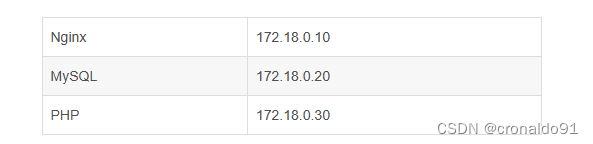
总目录如下:

2.准备Nginx镜像
(1) 创建nginx的工作目录


(2) 上传 软件包及配置文件到 /opt/nginx/ 目录中

(3)编辑Dockerfile配置文件
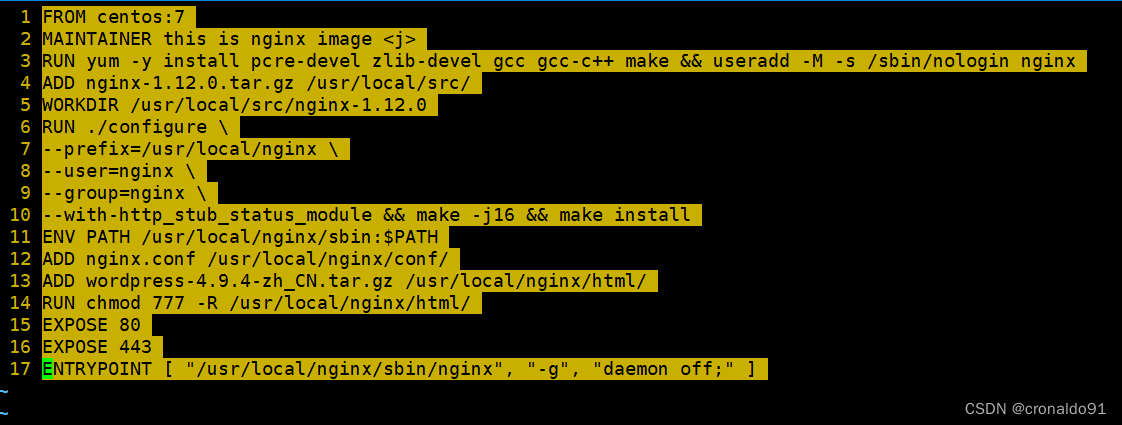
(4) 准备Dockerfile文件中所需要的其他配置文件

取消注释,指定PHP网页文件、指定IP和端口号

3.准备MySQL容器
(1) 创建MySQL工作目录

(2) 上传软件包及配置文件到 /opt/mysqld 目录中

(3) 编辑Dockerfile文件

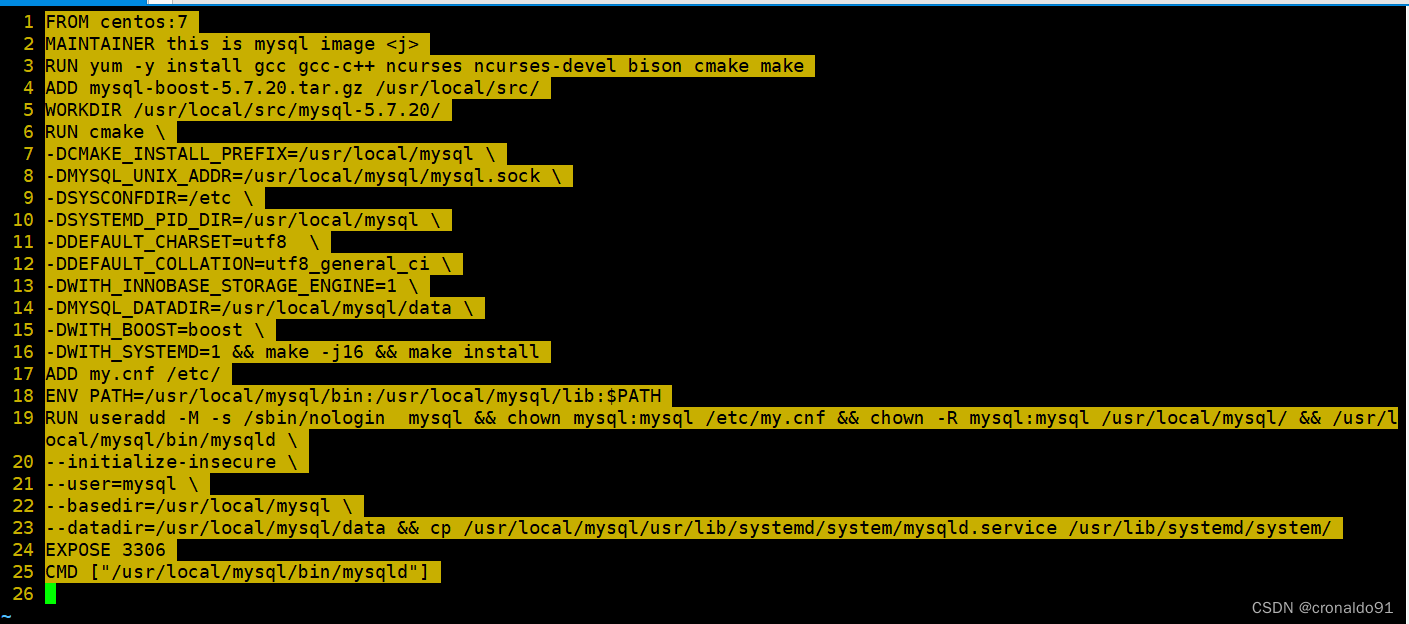
(4)编辑mysql的配置文件

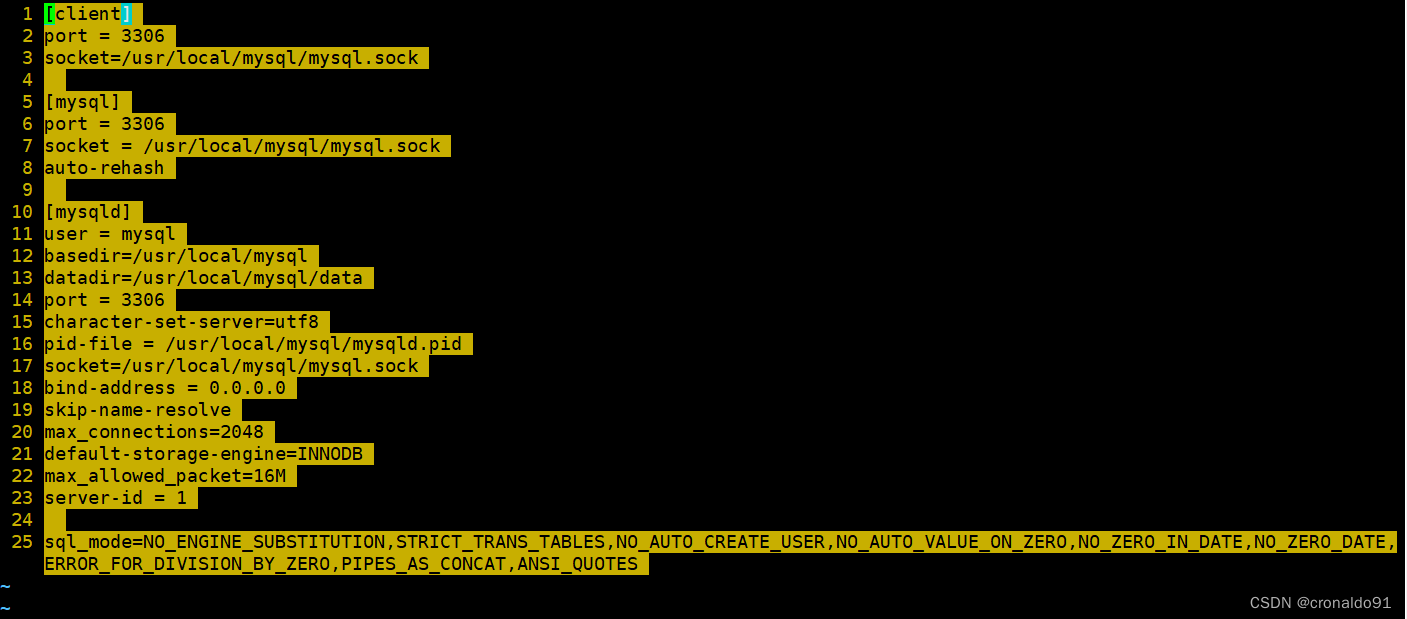
4.准备PHP镜像
(1) 创建工作目录
(2)上传软件及配置文件到 /opt/php 目录中

(3)编辑Dockerfile文件

(4)准备Dockerfile需要的PHP配置文件

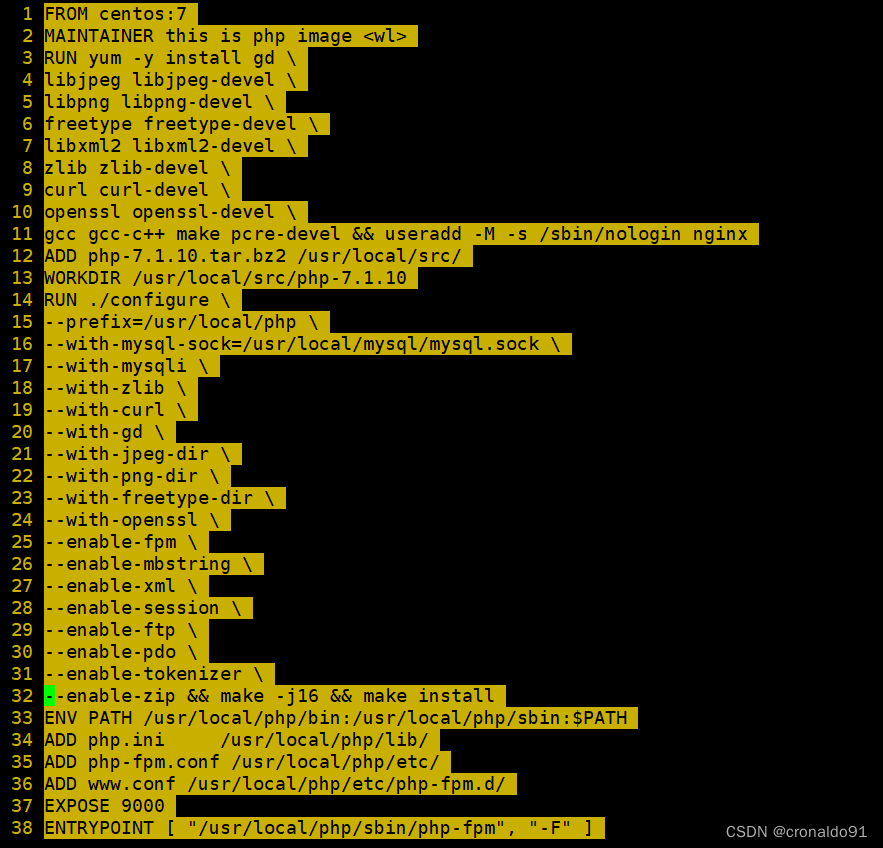
5.上传wordpress软件包
(1) 上传软件及网页文件到wwwroot目录

6.docker compose构建项目
(1)编辑文件

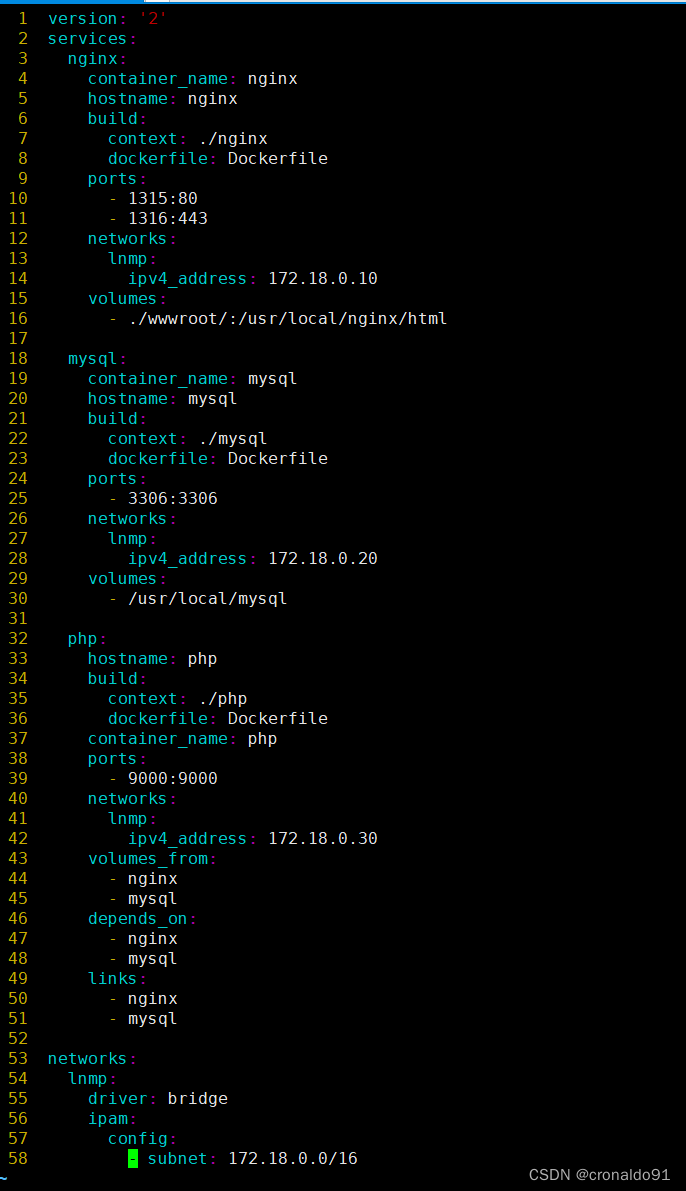
(2)运行项目

(3)完成

(4)查看状态

(5)查看docker compose进程

7.启动 wordpress 服务
(1)mysql 授权
进入mysql容器,登录数据库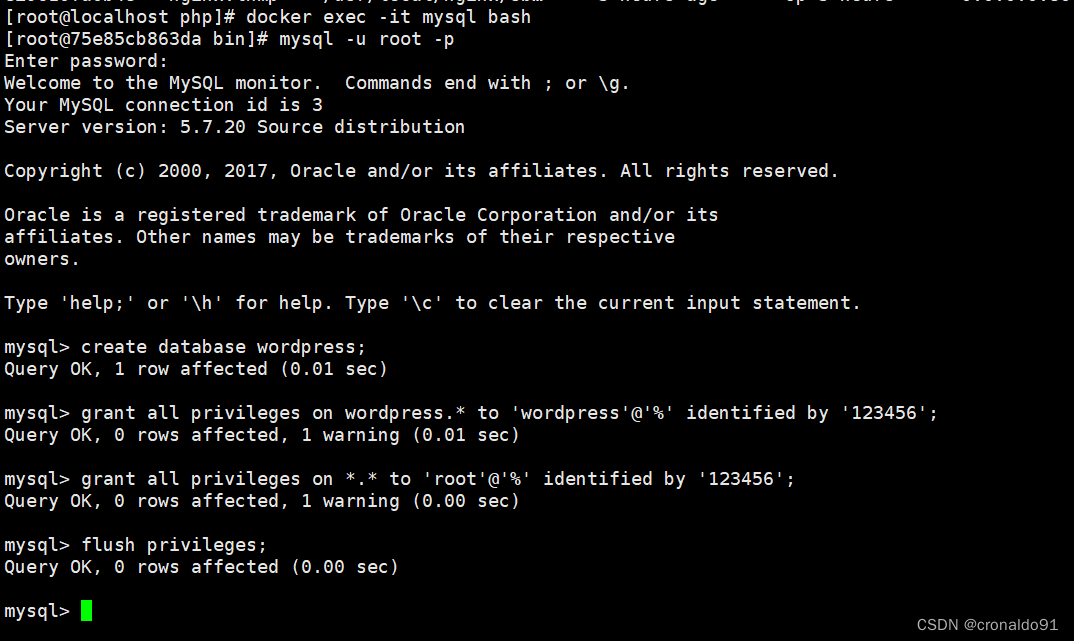
(2) 浏览器访问测试
http://192.168.204.141:1315/wordpress/wp-admin/setup-config.php进入配置页面
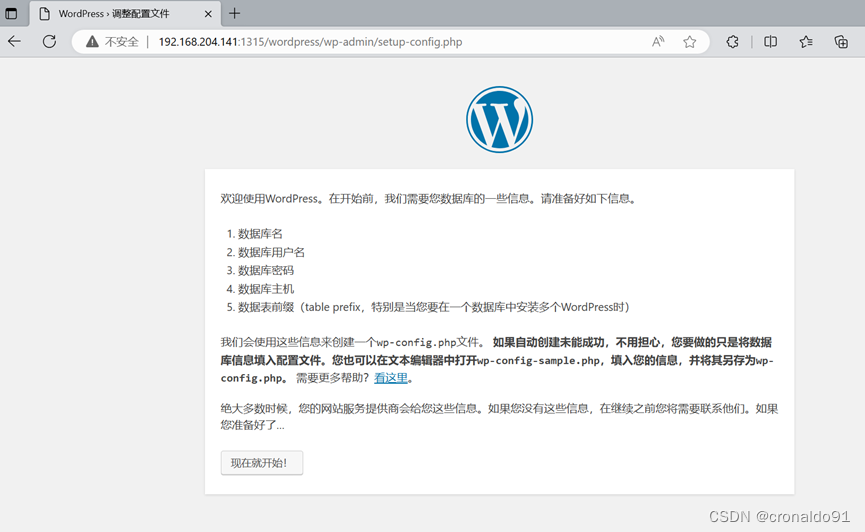
输入用户名和密码
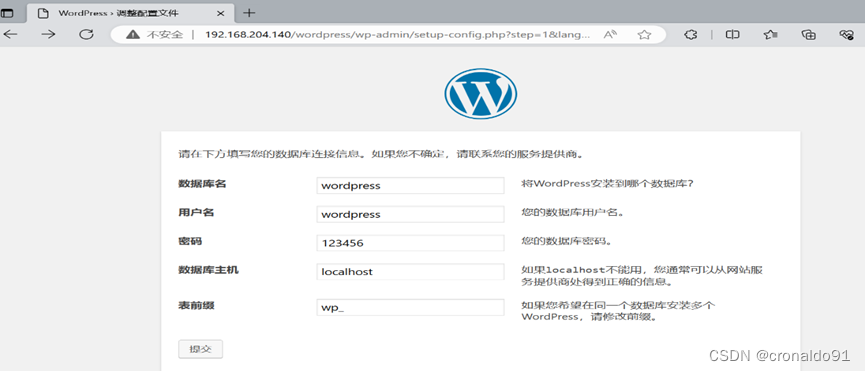
现在安装
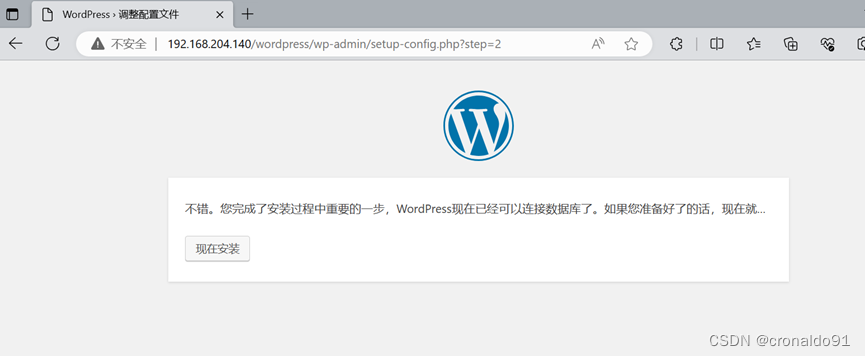
设置用户名和密码
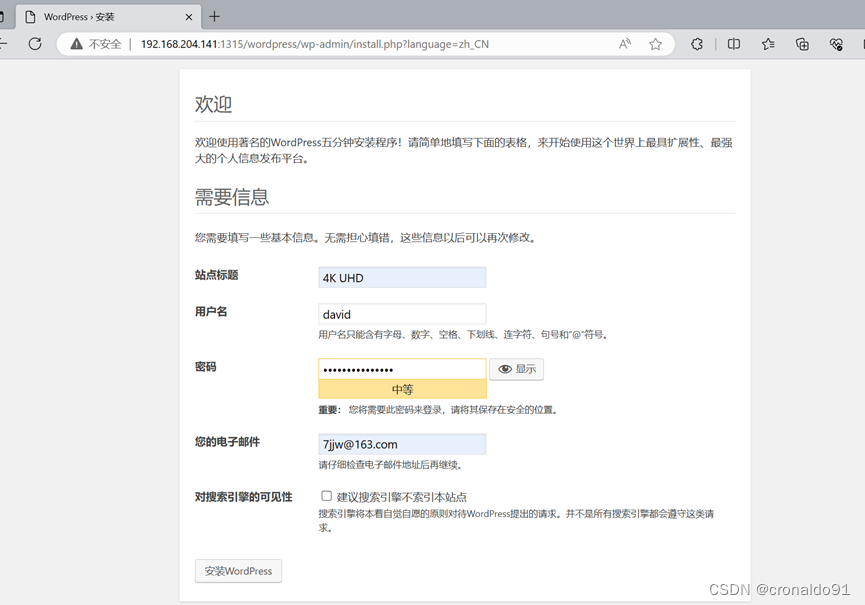
点击 登录

登录成功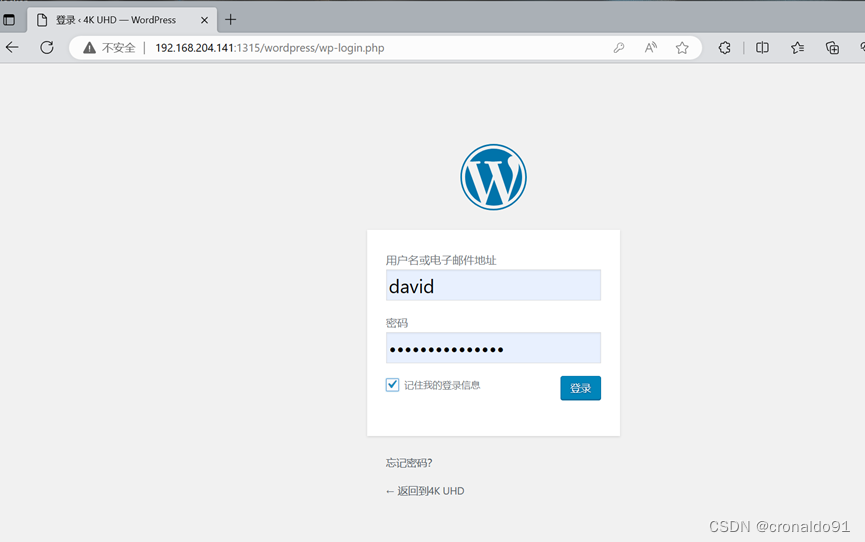
进入系统
http://192.168.204.141:1315/wordpress/wp-admin/
首页展示

8.将所有容器进行快照,然后将Docker镜像打包成tar包备份到本地
(1)查看

(2) 容器存为镜像

(3)查看镜像
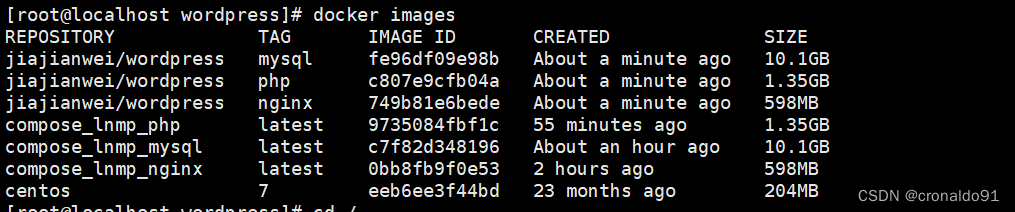
(4)镜像打包

三、问题
(1)报错
报错1
构建容器报错,ERROR: Pool overlaps with other one on this address space

(2)报错2
删除docker网卡,提示Error response from daemon: error while removing network
查看docker网卡

先解除关联
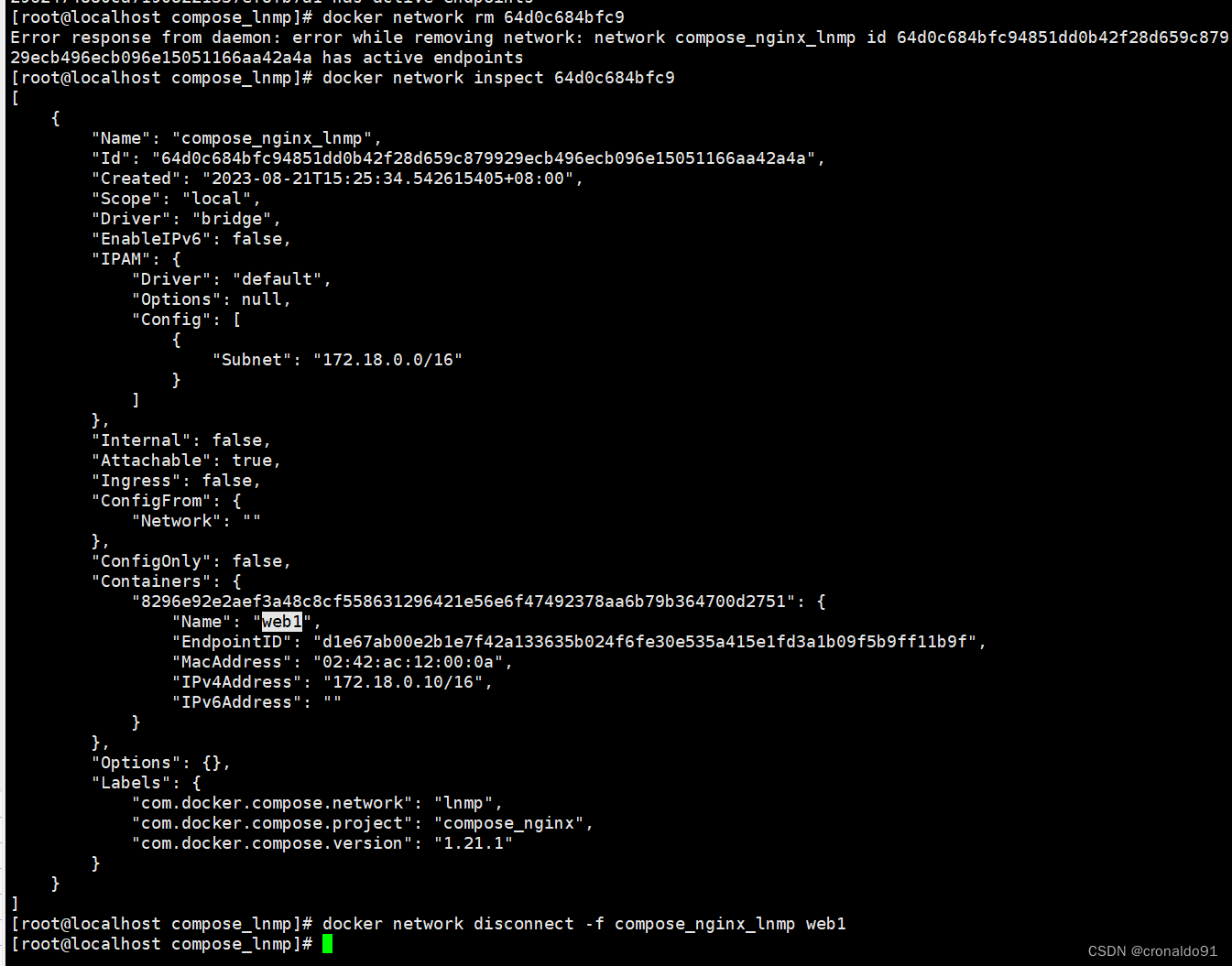
(3)解决
删除成功

处理另一个网段
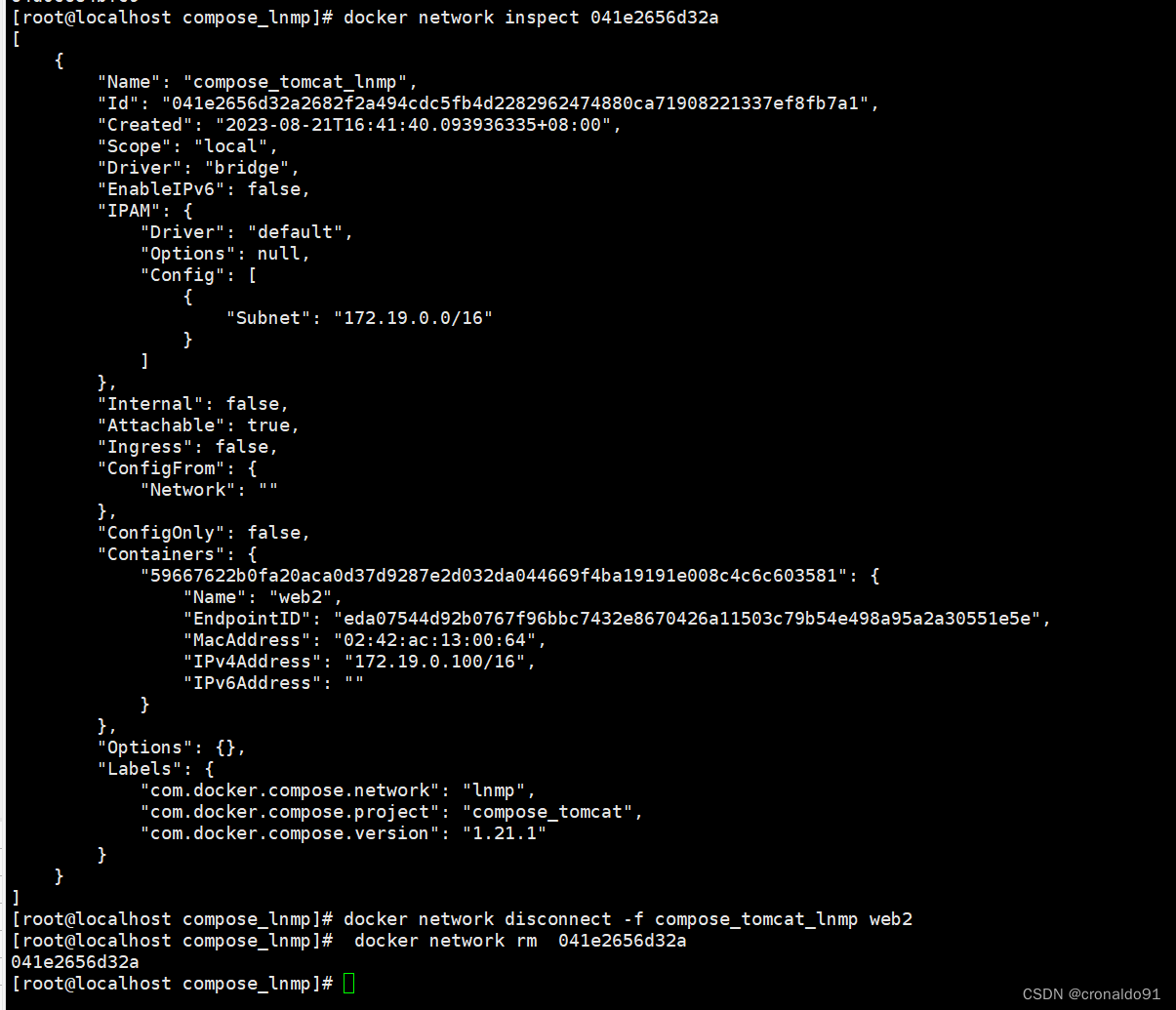
相关文章:
Docker容器与虚拟化技术:Docker compose部署LNMP
目录 一、理论 1.LNMP架构 2.背景 3.Dockerfile部署LNMP 3.准备Nginx镜像 4.准备MySQL容器 5.准备PHP镜像 6.上传wordpress软件包 7.编写docker-compose.yml 8.构建与运行docker-compose 9.启动 wordpress 服务 10.浏览器访问 11.将运行中的 docker容器保存为 doc…...
高性能服务器Nodejs操作Mysql数据库
目录 1 Node 操作 mysql1.2 操作 mysql 数据库 2 Web 开发模式2.1 服务端渲染2.2 前后端分离2.3 如何选择 3 身份认证3.1 Session 认证机制3.2 JWT 认证机制 1 Node 操作 mysql 数据库和身份认证 配置 mysql 模块 安装 mysql 模块 npm install mysql建立连接 const mysql …...

ffmpeg将rtsp流转成mp4
命令行版本 ffmpeg -y -i "rtsp://你的rtsp地址" -vcodec copy -f mp4 d:/1.mp4中间的rtsp网址一定要加上双引号,避免出现url有特殊字符的问题 java代码版本 如果不支持tcp协议,去掉下面两个参数即可,加上这两个参数是因为ffmpeg默认使用ud…...
、101. 对称二叉树 (优先掌握递归))
第十四天|层序遍历、226.翻转二叉树 (优先掌握递归)、101. 对称二叉树 (优先掌握递归)
层序遍历 题目链接:102. 二叉树的层序遍历 - 力扣(LeetCode) /*** Definition for a binary tree node.* struct TreeNode {* int val;* TreeNode *left;* TreeNode *right;* TreeNode() : val(0), left(nullptr), right(n…...
如何使用装rancher安装k8s集群(k8s集群图形化管理工具)
前言 kubernetes集群的图形化管理工具主要有以下几种: 1、 Kubernetes Dashborad: Kubernetes 官方提供的图形化工具 2、 Rancher: 目前比较主流的企业级kubernetes可视化管理工具 3、各个云厂商Kubernetes集成的管理器 4、 Kuboard: 国产开源Kubernetes可视化管理…...
类加载器与双亲委派
类加载器与双亲委派 Java 类加载器(Class Loader)是 Java 虚拟机(JVM)的一部分,负责将类的字节码加载到内存中,并将其转换为可执行的 Java 对象。类加载器在 Java 应用程序中起着重要的作用,它…...

用Python创造乐趣:编写你自己的探索游戏世界
在当今数字化时代,编程不再是一个专业程序员的专利。无论你是一个编程新手还是有一定经验的开发者,用Python编写简单的游戏是一个有趣且富有创造性的方式。在这篇博客中,我们将探索如何用Python构建一个基本的探索游戏世界,让玩家…...

git stash弹出栈中的指定内容
使用 git stash 的相关命令来选择性地弹出特定的 stash 内容,应用到指定的分支上。如果我们使用 git stash 命令已经存储了多个记录时,每个 stash 记录都会有一个唯一的标识符(stash{0}、stash{1}…)。通过这些标识符可以应用或弹…...

5.7 汇编语言:汇编高效乘法运算
乘法指令是一种在CPU中实现的基本算术操作,用于计算两个数的乘积。在汇编语言中,乘法指令通常是通过mul(无符号乘法)和imul(有符号乘法)这两个指令实现的。由于乘法指令在执行时所消耗的时钟周期较多&#…...

Graphql中的N+1问题
开篇 原文出处 Graphql 是一种 API 查询语言和运行时环境,可以帮助开发人员快速构建可伸缩的 API。然而,尽管 Graphql 可以提供一些优秀的查询性能和数据获取的能力,但是在使用 Graphql 的过程中,开发人员也会遇到一些常见问题&…...

mysql、oracle、sqlserver常见方法区分
整理了包括字符串与日期互转、字符串与数字互转、多行合并为一行、拼接字段等一些常用的函数,当然有些功能实现的方法不止一种,这里列举了部分常用的,后续会持续补充。 MySQLOracleSQL Server字符串转数字 CAST(123 as SIGNED) 或 CONVERT(12…...

AcWing 4382. 快速打字
原题链接:AcWing 4382. 快速打字 关键词:双指针、判断子序列 芭芭拉是一个速度打字员。 为了检查她的打字速度,她进行了一个速度测试。 测试内容是给定她一个字符串 I,她需要将字符串正确打出。 但是,芭芭拉作为一…...
DataFrame.query()--Pandas
1. 函数功能 Pandas 中的一个函数,用于在 DataFrame 中执行查询操作。这个方法会返回一个新的 DataFrame,其中包含符合查询条件的数据行。请注意,query 方法只能用于筛选行,而不能用于筛选列。 2. 函数语法 DataFrame.query(ex…...
【C语言】美元名字和面额对应问题
题目 美元硬币从小到大分为1美分(penny)5美分(nickel)10美分(dime)25美分(quarter)和50美分(half-dollar),写一个程序实现当给出一个数字面额可以…...
)
uniapp隐藏底部导航栏(非自定义底部导航栏)
uniapp隐藏底部导航栏 看什么看,要多看uni官方文档,里面啥都有 看什么看,要多看uni官方文档,里面啥都有 uniapp官方网址:uni设置TabBar // 展示 uni.showTabBar({animation:true,success() {console.debug(隐藏成功)…...
CSS background 背景
background属性为元素添加背景效果。 它是以下属性的简写,按顺序为: background-colorbackground-imagebackground-repeatbackground-attachmentbackground-position 以下所有示例中的花花.jpg图片的大小是4848。 1 background-color background-col…...
安防监控视频平台EasyCVR视频汇聚平台和税务可视化综合管理应用方案
一、方案概述 为了确保税务执法的规范性和高效性,国家税务总局要求全面推行税务系统的行政执法公示制度、执法全过程记录制度和重大执法决定法制审核制度。为此,需要全面推行执法全过程记录制度,并推进信息化建设,实现执法全过程的…...

深度学习实战50-构建ChatOCR项目:基于大语言模型的OCR识别问答系统实战
大家好,我是微学AI,今天给大家介绍一下深度学习实战50-构建ChatOCR项目:基于大语言模型的OCR识别问答系统实战,该项目是一个基于深度学习和大语言模型的OCR识别问答系统的实战项目。该项目旨在利用深度学习技术和先进的大语言模型,构建一个能够识别图像中文本,并能够回答与…...
计算机安全学习笔记(I):访问控制安全原理
访问控制原理 从广义上来讲,所有的计算机安全都与访问控制有关。 RFC 4949: Internet Security Glossary, Version 2 (rfc-editor.org) RFC 4949 定义的计算机安全:用来实现和保证计算机系统的安全服务的措施,特别是保证访问控制服务的措施…...
Linux 虚拟机安装 hadoop
目录 1 hadoop下载 2 解压hadoop 3 为 hadoop 文件夹改名 4 给 hadoop 文件夹赋权 5 修改环境变量 6 刷新环境变量 7 在hadoop313目录下创建文件夹data 8 检查文件 9 编辑 ./core-site.xml文件 10 编辑./hadoop-env.sh文件 11 编辑./hdfs-site.xml文件 12 编辑./mapr…...

5月12日直播 | CANN Bench:为昇腾算子评测立起一把统一的尺子
CANN Bench:为昇腾算子评测立起一把统一的尺子 当 Coding Agent 一次写出几十个算子已成为常态,"什么算优质算子"变成了一个单一维度无法评估准确的问题:能不能过编译只是入场券,精度是否经得起验证、换个 shape 换个 d…...

Next.js功能开关实践:用happykit/flags实现灰度发布与A/B测试
1. 项目概述:为什么我们需要一个功能开关系统?在软件开发,尤其是现代Web应用和微服务架构的迭代过程中,我们经常面临一个经典困境:新功能开发完成后,是直接全量发布给所有用户,还是先小范围灰度…...

使用Taotoken CLI工具一键配置多开发环境下的API访问密钥
🚀 告别海外账号与网络限制!稳定直连全球优质大模型,限时半价接入中。 👉 点击领取海量免费额度 使用Taotoken CLI工具一键配置多开发环境下的API访问密钥 在团队协作或个人多设备开发场景中,为不同的AI开发工具&…...

终极指南:如何使用Cherry MX键帽3D模型库打造你的专属机械键盘
终极指南:如何使用Cherry MX键帽3D模型库打造你的专属机械键盘 【免费下载链接】cherry-mx-keycaps 3D models of Chery MX keycaps 项目地址: https://gitcode.com/gh_mirrors/ch/cherry-mx-keycaps 想要打造一把真正属于自己的机械键盘吗?厌倦了…...

从‘咖啡环’到‘热点’富集:超疏水表面如何将SERS检测灵敏度提升几个数量级?
从“咖啡环效应”到分子富集革命:超疏水表面如何重塑痕量检测极限 清晨的咖啡杯边缘总留下一圈深色痕迹,这个看似普通的日常现象背后,隐藏着改变分子检测游戏规则的物理机制。当科研人员将这种被称为"咖啡环效应"的液滴蒸发现象与表…...

书匠策AI让我的课程论文从“赶死线“变成了“喝茶局“
先交代背景。 上个月,我接了一个"极限挑战":一周五门课,四门要交课程论文,最短的截止日期只剩48小时。 说实话,那一刻我脑子里只有两个字——完蛋。 但作为一个天天教别人写论文的博主,我总不…...

终极指南:在Windows上无需模拟器安装安卓应用的完整教程
终极指南:在Windows上无需模拟器安装安卓应用的完整教程 【免费下载链接】APK-Installer An Android Application Installer for Windows 项目地址: https://gitcode.com/GitHub_Trending/ap/APK-Installer 还在为安卓模拟器的臃肿和卡顿烦恼吗?今…...

内向技术人突破领导力瓶颈:从深度思考到战略沟通的进阶指南
1. 项目概述:内向工程师的“天花板”与破局之路 在技术圈子里待久了,你会发现一个有趣的现象:身边那些能写出精妙算法、搞定复杂架构的工程师,往往在茶水间的闲聊中显得沉默寡言,在大型会议上也更倾向于坐在后排。这并…...

iOSDeviceSupport终极指南:如何快速解决Xcode设备支持文件缺失问题
iOSDeviceSupport终极指南:如何快速解决Xcode设备支持文件缺失问题 【免费下载链接】iOSDeviceSupport All versions of iOS Device Support 项目地址: https://gitcode.com/gh_mirrors/ios/iOSDeviceSupport 你是否曾经在iOS开发中遇到过这样的困扰…...

终极指南:5步安装Koikatu HF Patch解锁完整游戏体验
终极指南:5步安装Koikatu HF Patch解锁完整游戏体验 【免费下载链接】KK-HF_Patch Automatically translate, uncensor and update Koikatu! and Koikatsu Party! 项目地址: https://gitcode.com/gh_mirrors/kk/KK-HF_Patch KK-HF Patch是专为《恋活…...